
If your accounting year closed on 31 March 2026, the statutory bonus under the Code on Wages for FY 2025-26 must reach your employees' bank accounts by 30 November 2026. This is the first bonus cycle run fully under the Code on Wages, 2019, which replaced the Payment of Bonus Act, 1965. In August 2026 the Centre also notified the wage limits that decide who is eligible and how the bonus is worked out. This guide covers eligibility, calculation, the due date and the checks HR and payroll teams should finish before the money goes out.
Statutory bonus at a glance (FY 2025-26)
| Point | What the Code on Wages says |
|---|---|
| Who must pay | Establishments where 20 or more persons are or were employed on any day of the accounting year (Section 41(2)) |
| Eligible employee | Wages not above ₹21,000 a month, and at least 30 days' work in the year (Section 26(1) read with S.O. 4711(E)) |
| Calculation ceiling | If wages are above ₹7,000 a month, calculate as if wages were ₹7,000 or the minimum wage, whichever is higher (Section 26(2) read with S.O. 4710(E)) |
| Minimum bonus | 8.33% of wages earned, or ₹100, whichever is higher, even with no allocable surplus |
| Maximum bonus | 20% of wages earned, out of allocable surplus |
| Due date | Within 8 months of the close of the accounting year, by bank credit. For a March year-end, that is 30 November 2026 (Section 39) |
What changed from the old Payment of Bonus Act
The bonus rules now sit in Chapter IV (Sections 26 to 41) of the Code on Wages, 2019, which came into force on 21 November 2025. Most of the familiar structure carries over: a minimum of 8.33%, a maximum of 20%, allocable surplus, and set-on and set-off. Two practical points are new for payroll teams.
First, the Code itself does not fix the eligibility limit or the calculation ceiling. It leaves both to the "appropriate Government". On 25 August 2026 the Ministry of Labour and Employment notified both for the central sphere, and both notifications apply from 21 November 2025:
- S.O. 4711(E) says every employee drawing wages of not more than ₹21,000 a month is entitled to bonus (Gazette notification on labour.gov.in).
- S.O. 4710(E) says that where wages are above ₹7,000 a month, bonus is calculated as if the wage were ₹7,000 or the minimum wage fixed by the Central Government, whichever is higher.
Second, the payment must be made by crediting the employee's bank account. Cash payouts on the shop floor do not meet Section 39.
The Ministry's own Compilation of FAQs on the Labour Codes (as on 25.10.2026) confirms that the ₹21,000 ceiling continues under the August 2026 notification. If the State Government is the appropriate Government for your unit, check whether your state has notified its own figures.
Statutory bonus eligibility: who gets it
An employee qualifies when all three conditions are met:
- The establishment is covered, meaning it had 20 or more persons on any day of the accounting year and is not excluded under Section 41(1).
- The employee's wages are not more than ₹21,000 a month.
- The employee has worked at least 30 days in the accounting year.
The Ministry's FAQ also makes clear that daily-wage workers are not excluded. Bonus is payable to every employee who has worked at least 30 days within the wage ceiling.
Excluded categories (Section 41(1)) include employees of LIC and RBI, seamen, registered dock workers, establishments run by a government department or local authority, the Indian Red Cross Society, universities and educational institutions, and non-profit hospitals and social welfare institutions.
Disqualification (Section 29). An employee dismissed for fraud, riotous or violent behaviour on the premises, theft, misappropriation or sabotage of property, or conviction for sexual harassment loses the right to bonus.
How to calculate statutory bonus
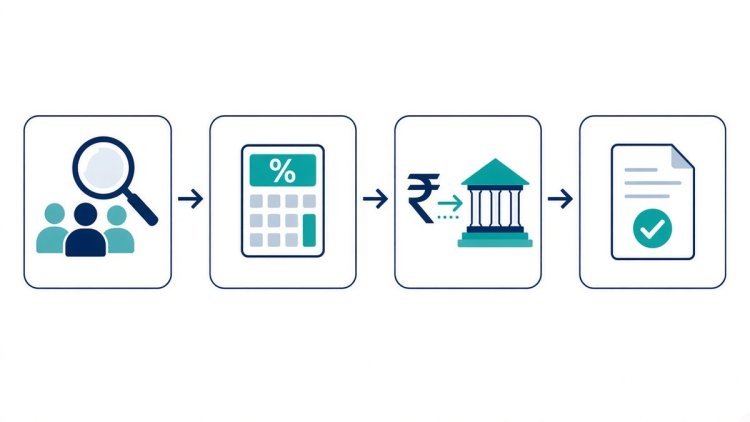
The calculation works in three layers.
1. Find the calculation base
Take the employee's monthly wages. If they are above ₹7,000, use ₹7,000 or the applicable minimum wage, whichever is higher. In practice the minimum wage almost always exceeds ₹7,000, so bonus calculation on minimum wages is now the norm. Use the minimum wage that applies to the employee's skill category and area.
Under Section 2(y), "wages" for the Labour Codes means basic pay, dearness allowance and retaining allowance, with excluded allowances added back where they cross 50% of total pay. Our explainer on the definition of wages under the new Labour Codes covers this in detail.
2. Apply the rate
- Minimum: 8.33% of the wages earned in the year, or ₹100, whichever is higher. This is payable even if the company made a loss.
- Above the minimum: if the allocable surplus is larger than the total minimum bonus, pay in proportion to wages, up to 20%.
3. Adjust for days worked
Under Section 27, if an employee did not work all working days, the minimum bonus is reduced in proportion. Section 28 counts certain days as worked: lay-off under an agreement or standing orders, paid leave, absence due to a work injury, and paid maternity leave.
Illustration (assumed figures): an employee earns ₹18,000 a month and worked the full year. Assume the applicable minimum wage is ₹12,000 a month. The calculation base is ₹12,000, because it is higher than ₹7,000. Annual base: ₹1,44,000. Minimum bonus at 8.33% is about ₹12,000. The maximum at 20% is ₹28,800. Swap in your actual notified minimum wage before you run payroll.
New establishments: for the first five accounting years after an establishment starts selling goods or rendering services, bonus is payable only for years in which it makes a profit, under Section 26(6). Special set-on/set-off rules apply in the sixth and seventh years.
Statutory bonus payment due date
Section 39 sets the timeline:
- General rule: within 8 months from the close of the accounting year. For 1 April 2025 to 31 March 2026, the date is 30 November 2026.
- Extension: the appropriate Government can extend the period on the employer's application for sufficient reasons. The total extension cannot exceed two years.
- Pending dispute: pay within one month of the award becoming enforceable or the settlement coming into operation. If the dispute is only about a higher rate, the 8.33% minimum must still be paid within the 8 months.
Contract and outsourced workers: the principal employer is on the hook
Bonus for contract labour is the contractor's job, but the risk does not stop there. The Ministry's FAQs say that if a contractor fails to pay wages or bonus, the principal employer must pay and can then recover the amount from the contractor's dues or security deposit. In November 2026 the Delhi Labour Department issued an advisory reminding government departments and PSUs to make sure outsourced staff receive their 2025-26 bonus by 30 November, warning that principal employers are liable if contractors default (The Pioneer report).
Ask every vendor for bank-credit proof of bonus payment before you release their final invoices. Our guide to labour law compliance for contract employees explains how to build this into vendor audits.
Pre-payout checklist for HR and payroll
- Confirm the headcount test: 20 or more persons on any day of FY 2025-26.
- Pull the list of employees with wages up to ₹21,000 a month and 30 or more days worked.
- Map each employee to the correct minimum wage (state or central, skill category, area).
- Recompute "wages" under Section 2(y), including the 50% add-back.
- Finalise the allocable surplus and the bonus rate, from 8.33% to 20%.
- Apply proportionate reduction for partial-year employees and include the deemed days.
- Flag employees dismissed for the reasons in Section 29.
- Credit the bonus to bank accounts on or before 30 November 2026 and keep the bank file.
- Collect bonus-payment proof from all contractors.
- Update your registers and add the next cycle to your statutory compliance calendar.
Common mistakes to avoid
- Using the old ₹7,000 base without checking minimum wages. The base is the higher of ₹7,000 and the minimum wage. Using a flat ₹7,000 underpays.
- Mixing up eligibility and calculation. The ₹21,000 limit decides who gets the bonus. The ₹7,000 or minimum-wage figure decides how much.
- Paying in cash or by cheque. The Code requires a bank credit.
How Digiliance can help
Digiliance's payroll compliance services cover bonus eligibility checks, calculations, payout files and contractor verification under the Code on Wages. Our labour law compliance software tracks due dates, minimum wage changes and registers across every state you operate in. Need your FY 2025-26 bonus checked before 30 November? Talk to the Digiliance team.
FAQs on statutory bonus under the Code on Wages
1. What is the last date to pay statutory bonus for FY 2025-26? For an accounting year ending 31 March 2026, the bonus must be credited to employees' bank accounts by 30 November 2026, which is 8 months from the year-end under Section 39.
2. What is the statutory bonus limit in 2026? For the central sphere, employees drawing wages up to ₹21,000 a month are eligible (S.O. 4711(E)). For calculation, wages above ₹7,000 are capped at ₹7,000 or the minimum wage, whichever is higher (S.O. 4710(E)).
3. Is statutory bonus payable if the company made a loss? Yes. The minimum bonus of 8.33% of wages, or ₹100 if higher, is payable whether or not there is an allocable surplus. The exception is the profit-only rule for the first five accounting years of a new establishment.
4. Is statutory bonus part of "wages" for PF and gratuity? No. Bonus is excluded from "wages" under Section 2(y) of the Code on Wages, as the Ministry's FAQs confirm.
5. Who pays bonus to contract workers? The contractor pays first. If the contractor defaults, the principal employer must pay and can recover the amount from the contractor.
Disclaimer: This article is for general information and reflects the Code on Wages, 2019 and notifications available as of 11 November 2026. Check your state's notifications and take professional advice for your specific case.