
Last March, Neha (she heads HR at a 40-person SaaS outfit in Gurugram) got the email she'd half dreaded. A developer leaving after four years and eight months asked, before his F&F was even processed, about gratuity. Neha wasn't sure. Neither was her CA.
That's the gratuity act for you. On a slide, one formula; in a real exit, with finance chasing closure, every clause pulls its weight.
So, slowly: coverage, the five-year puzzle, arithmetic, tax, deadlines, then what the labour codes rearranged.
What the Gratuity Act Really Asks of You
Put plainly, you owe a long-serving employee a lump sum when they leave. Not a goodwill gesture. A legal debt, and no amount of clever wording in a full and final settlement letter will waive it.
You fund it yourself; nothing is shaved off in-hand pay. An Indore founder learnt the rest at conciliation: the Payment of Gratuity Act, 1972 is the minimum, and his richer offer-letter clause bound him.
Then, in November 2025, the Code on Social Security, 2020 absorbed the old statute. Same engine, new body.
Payment of Gratuity Act 1972 and the Ten-Employee Line
Size never saves a factory, mine, oilfield, plantation, port or railway company. A shop or office under your state's Shops and Establishments law crosses over once it has 10 people on its rolls on any day in the previous 12 months.
That "any day" catches people. Eleven staff for one October week, as a Bengaluru agency found, is enough.
And it sticks. Headcount drops to seven next year? Still covered. There's no salary ceiling either (your CXO qualifies just like the office assistant), though apprentices fall outside.
Gratuity Eligibility: The Questions We Get Every Week
Five years, and what counts as continuous
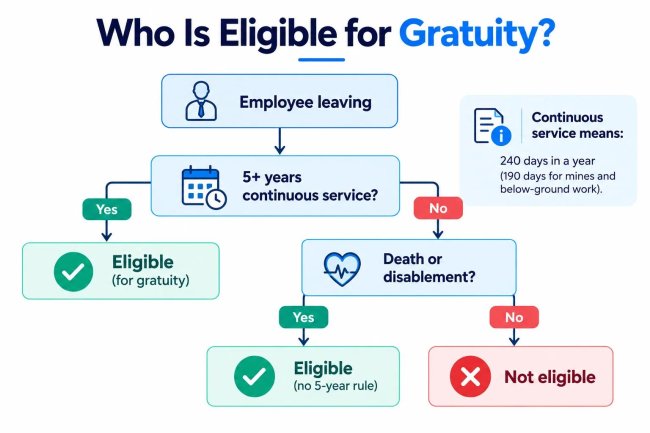
The gratuity act's core test hasn't moved in decades: five years of continuous service. Retirement, superannuation, resignation, even termination by you all count, barring forfeiture cases.
Three months off after knee surgery in July: does service break? Mostly no. Section 2A keeps service alive through sickness, accident, approved leave, lay-off, a legal strike, a lockout, or any stoppage that wasn't the employee's doing.
When five years don't matter
Death. Disablement from an accident or illness. Either way the five-year requirement disappears, and the money goes to the nominee or, failing that, to the legal heirs.
We once saw a Nashik family wait almost four months because nobody could find the nomination form. Avoidable.
Short years: the 240-day test, and its 190-day cousin
Broken years happen. The law still credits a full year if the employee actually put in 240 days in the preceding 12 months; underground in a mine, or where the week is under six days, 190. Seasonal units? 75% of the days they operated.
Now, Neha's developer. Some High Courts have used the 240-day logic to count that fifth year, others haven't. We'd get a legal opinion before saying no.
Gratuity Calculation Formula, Worked Through
Covered employers: the 15/26 formula
Gratuity = Last drawn monthly wages x 15/26 x Completed years of service
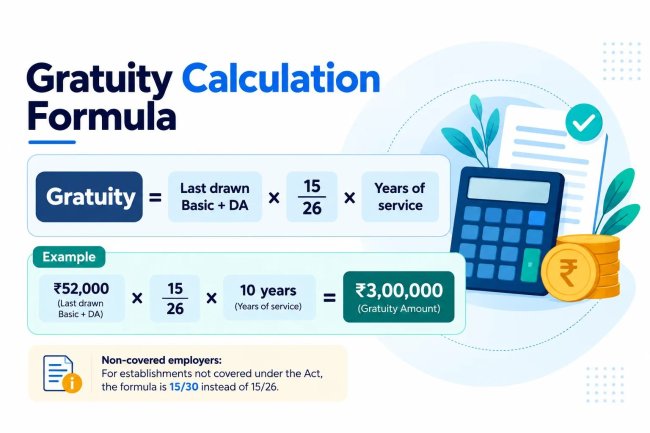
Under the gratuity act, "wages" is basically basic pay plus DA. Not CTC. HRA, bonus, commission, overtime and other allowances stay out, though the Code's 50% rule can pull some of them back in. Feed a gratuity calculator the CTC figure and it will overpay every time.
Why 26? The law assumes 26 working days a month, so 15/26 gives you fifteen days' pay per year. Served more than six months of the last year? Round it up.
Piece-rated staff? Average of the last three months' wages. Seasonal units pay seven days' wages per season.
Example 1: the Pune plant
Priya joined a Chakan auto-components plant near Pune in August 2016 and left in March 2026. That's 9 years 7 months, so 10 years for our purpose. Her last basic plus DA: Rs 52,000.
52,000 x 15/26 = Rs 30,000 a year. Times ten, Rs 3,00,000.
Non-covered employers: the 15/30 formula
A small firm below the threshold isn't legally bound to pay anything. Many pay anyway, through policy. For tax, the exempt part is half a month's average salary for each completed year, averaged over the ten months before the month of exit, part years ignored.
Example 2: the seven-person studio
Rahul spent 12 years 9 months at a Kochi design studio with seven staff. His ten-month average basic plus DA was Rs 39,000. The nine months? Gone. So 39,000 x 15/30 x 12 = Rs 2,34,000 tax-free, and anything the studio pays on top is taxed as salary.
Running an F&F this month and not fully sure about the number? Talk to a Digiliance compliance expert before it goes out.
The Gratuity Limit: Rs 20 Lakh
Until 29 March 2018 the cap sat at Rs 10 lakh. The 2018 amendment let the Centre set the ceiling by notification, and it notified Rs 20 lakh. That's the most the gratuity act can make you pay. Pay more if you like; the excess is taxed.
Tax on Gratuity (and the New Income-tax Act)
Government staff owe nothing. For anyone covered by the gratuity act, the taxman takes the smallest of three numbers (actual payout, the 15/26 result, Rs 20 lakh) as tax-free; at a non-covered employer, the half-month average replaces the middle one.
A Chennai controller once asked why a rehire's exemption fell short. The Rs 20 lakh is lifetime, and his last employer had used some.
Payroll folks, check your Form 16 notes. Gratuity paid before 1 April 2026 still falls under Section 10(10) of the 1961 Act. From that date, look for it under Section 19 of the Income-tax Act, 2025 (the Income Tax Department's portal carries the text).
30 Days to Pay, Then Interest
The clock starts the day gratuity becomes payable. Within 30 days you work out the amount, tell the employee and the controlling authority in writing, and pay.
Late? Simple interest runs from the due date at the rate the Central Government notifies for long-term deposit repayments. The only escape is a delay the employee caused, and only if the controlling authority accepts it.
Under the Social Security (Central) Rules, 2026 (notified 8 May 2026), the employee applies in Form IV, ordinarily within 30 days. A legal heir gets a year. You can't reject a claim just because it came late. Within 15 days you issue Form V. It either confirms the amount and a payment date no later than 30 days from the application, or rejects the claim with reasons. Older claims under the 1972 rules used Forms I, L, M and N for the same steps.
Nomination in Form III
Ask HR teams when the nomination is due and you'll hear guesses. Under the 2026 Central Rules, it's Form III, within 90 days of finishing a year of service. Staff already on the rolls had 90 days from the start of the rules. (The old 1972 form was Form F.) With a family, nominees come from it, and splitting shares between a wife and an ageing father is allowed.
Our advice? Clip Form III to the one-year confirmation letter, and ask again whenever a wedding or baby pops up in the team WhatsApp group.
Can You Forfeit Gratuity?
Rarely. Section 4(6) of the gratuity act carves out just two doors.
First door: damage. Sack a storekeeper whose act, wilful omission or negligence cost you stock, and gratuity can be held back, capped at that loss. Door two is misconduct territory (riotous or disorderly behaviour, violence, an offence involving moral turpitude in the course of employment); forfeiture there can be partial or total.
Notice the word termination. A Hyderabad firm tried forfeiting after the employee had resigned and served notice; the controlling authority wasn't impressed. You need termination on that ground, an inquiry, a written order and the loss on paper.
Employer Duties Under the Gratuity Rules
Paying on time is obvious. Inspectors look further.
They'll want to see the written notice of the amount (sent to both the employee and the controlling authority) and an abstract of the gratuity act and rules on display, in English and the local language. Honestly, this is where most audits go wrong. The abstract went up in 2014 and nobody's looked since.
Where the government has notified it under Section 4A, you must also insure the liability or run an approved gratuity fund. Keep nominations filed, and make an actuarial provision so April's audit holds no surprises.
Gratuity Under New Labour Code Rules
Ask a labour lawyer where gratuity "lives" now and you'll get two answers. On paper, the Payment of Gratuity Act became Chapter V of the Code on Social Security, 2020 on 21 November 2025. The Central rules took till May 2026.
And the states? Slower. They notify rules at their own pace, and a pre-switch claim may run under the old law, so check the Ministry of Labour and Employment website.
Gratuity for fixed term employees
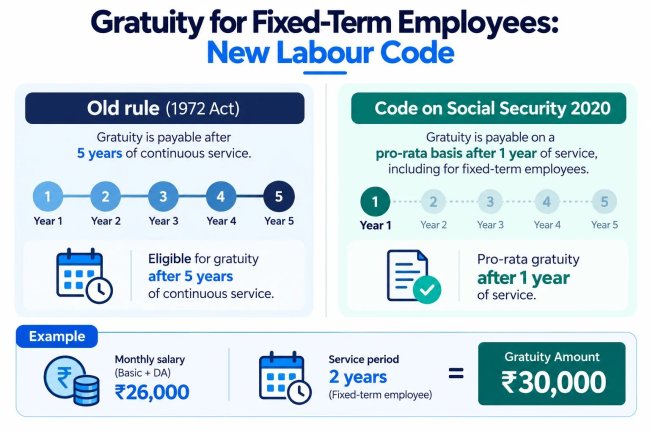
The big one. Finish one year on a fixed-term contract and gratuity is now owed, pro rata, with any leftover stretch beyond six months bumped up to a full extra year.
Our Noida example: an analyst, Rs 26,000 a month, contract over at 1 year 7 months. She's paid for 2 years: 26,000 x 15/26 x 2, or Rs 30,000 (zero under the old rules). Working journalists qualify after three years.
Allowances under watch: the 50% wage rule
CTC structures long kept basic lean and parked the rest in allowances. Under the Code, anything excluded beyond half of total pay counts back into wages.
We ran this for a Mumbai fintech in January. A Rs 1,00,000 monthly package, only Rs 40,000 of it basic plus DA, left Rs 60,000 in allowances, Rs 10,000 beyond what the Code tolerates. Back it went: gratuity base, Rs 50,000. Our explainer on what the new labour codes change for employers covers the rest.
Penalties for Getting It Wrong
Lying costs most. Under Section 9 of the Payment of Gratuity Act, a false statement to dodge payment risks six months in jail, a Rs 10,000 fine, or both.
Other defaults look minor until written up: three months to a year inside, a Rs 10,000 to Rs 20,000 fine, or both. Not paying at all? Six months to two years, unless the court records reasons to go lighter. Unpaid sums are recovered like land revenue arrears, and post-November 2025 defaults may sit under the Code's own penalties.
The 1972 Act vs the Social Security Code
Most of what you already do under the gratuity act still holds. The five-year rule for permanent staff, 15/26, the 30-day deadline, the death and disablement exception, all of it carried across.
What changed is narrower but costly: fixed-term staff, wider wages, a notified ceiling.
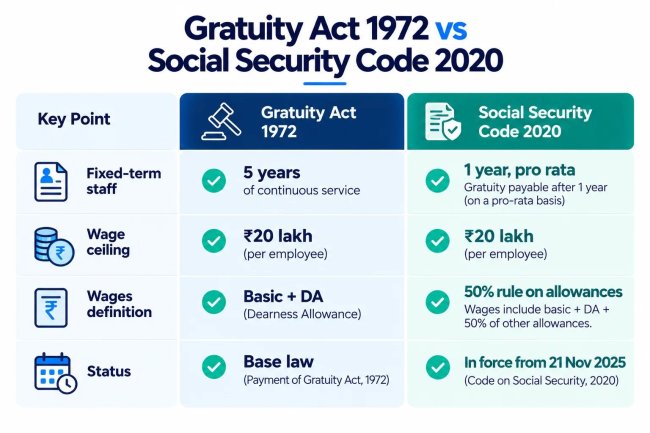
| Point | Gratuity Act 1972 | Social Security Code |
|---|---|---|
| Status | Subsumed | In force, 21 Nov 2025 |
| Threshold | 10+ staff | 10+ staff |
| Permanent staff | 5 years | 5 years |
| Fixed-term staff | 5 years | 1 year, pro rata |
| Death/disablement | No minimum | No minimum |
| Wages | Basic + DA | 50% add-back |
| Formula | 15/26 | 15/26 |
| Ceiling | Rs 20 lakh | Rs 20 lakh (as notified) |
| Deadline | 30 days | 30 days |
Where Digiliance Fits In
Most gratuity trouble we clean up isn't fraud. This July to September: a nomination form stuck in a drawer, a workbook multiplying CTC by 15/26, and a September exit that slid past day 30 while the lone HR manager was in Goa.
Fixing that is most of what our payroll compliance services team does: mapping covered units, rerunning numbers for permanent and fixed-term staff, keeping files inspection-ready. Tricky claims and notices go to our labour law compliance advisors; tracking runs on our labour law compliance software.
Gratuity Act FAQs: Real Questions From HR Teams
"Is the gratuity act even the right law to quote any more?"
A Pune HR head asked us in June. Our reply, roughly: quote the Payment of Gratuity Act, 1972 for the logic (lump sum after five years' continuous service, sooner on death or disablement), but know that since 21 November 2025 it mostly lives inside the Code on Social Security, 2020.
"Our employee did 4 years and 8 months. Do we have to pay?"
Maybe. If they worked 240 days in that fifth year, some courts would say yes. Get advice first.
"How do I calculate gratuity quickly?"
Last basic plus DA, times 15, divided by 26, times years served. Final year over six months? Round up.
"Is there an upper limit?"
Yes, Rs 20 lakh. Pay above it if you like; the employee is taxed on the extra.
"Will the employee pay tax on it?"
Mostly not. For covered employees the lowest of actual payout, formula amount and Rs 20 lakh is exempt; government staff pay nothing.
"He caused us a loss before leaving. Can we hold back his gratuity?"
Only if you terminated him for that reason after a proper inquiry, and only up to the actual loss. Resigned first, discovered later? You'll almost certainly pay.
"Do our fixed-term hires get gratuity now?"
Yes, once they've done at least one year. It's pro rata.
"We're down to eight people. Can we stop?"
No, not if you were ever covered. Coverage doesn't switch off when headcount falls.
Before You Close the Next F&F
Get the gratuity act right and nobody notices. Get it wrong and it's interest, a complaint before the controlling authority, and an ex-employee venting on LinkedIn.
Redoing salary structures for the code? Got a claim you'd rather not guess at? We'll go through it with you.