If you employ ten or more people and even one of them is a woman, the Maternity Benefit Act applies to you. The core duty has not changed in 2026: a qualifying woman employee is entitled to 26 weeks of fully paid leave, her job is protected while she is away, and you cannot treat her absence as a break in service. What has changed is where the rule now lives. Since 21 November 2025 the four labour codes are in force, and maternity benefit sits in Chapter VI of the Code on Social Security, 2020, with the central rules notified on 8 May 2026.
This guide sets out what an employer actually has to do, in the order it comes up: who is covered, how much leave is owed, what you pay, the creche duty, and what happens if you get it wrong.
Who the Maternity Benefit Act applies to
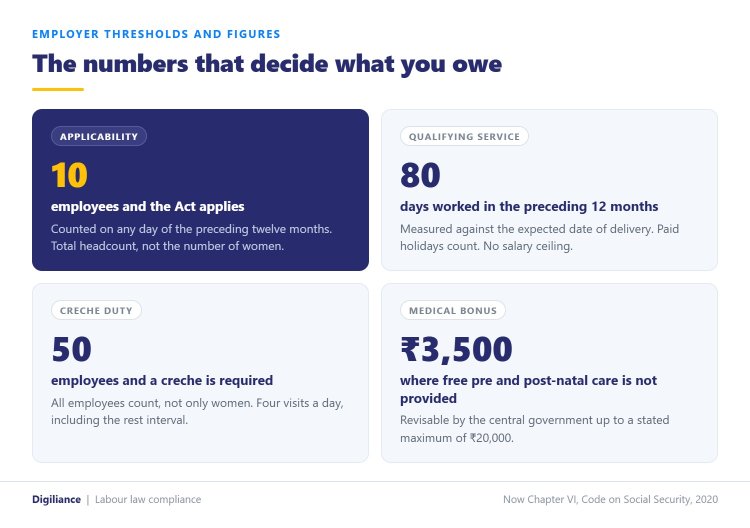
The Act covers every establishment employing ten or more persons, counted on any day of the preceding twelve months. That includes factories, mines, plantations, shops and commercial establishments. The threshold is on total headcount, not on the number of women employed, so a ten person office with one woman employee is covered in full.
A woman employee qualifies for maternity benefit if she has worked for at least 80 days in the twelve months immediately preceding her expected date of delivery. Paid holidays count towards those 80 days. There is no salary ceiling, so the entitlement applies equally to a factory floor operator and a senior manager.
One carve out matters in practice. Where a woman is covered under the Employees' State Insurance scheme and is drawing maternity benefit from ESIC, the employer is not separately liable under this Act for the same period. If your wage bill straddles the ESI wage ceiling, you will be running both routes side by side, which is why your ESIC compliance records and your maternity register need to reconcile against each other.
Leave entitlement: how many weeks and when
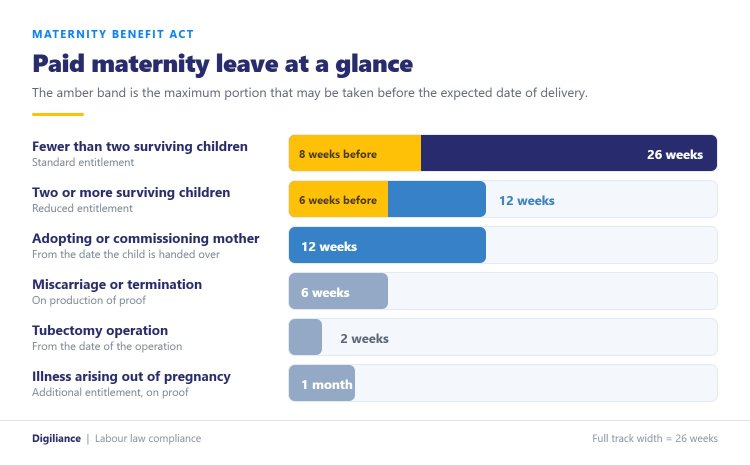
The entitlement is tiered by the number of surviving children the woman already has.
- Fewer than two surviving children: 26 weeks of paid leave, of which not more than 8 weeks may be taken before the expected date of delivery.
- Two or more surviving children: 12 weeks of paid leave, of which not more than 6 weeks may be taken before the expected date of delivery.
- Adopting mother (adopting a child below three months of age) and commissioning mother: 12 weeks from the date the child is handed over.
- Miscarriage or medical termination of pregnancy: 6 weeks of paid leave from the date of the event, on production of proof.
- Tubectomy operation: 2 weeks of paid leave from the date of the operation.
- Illness arising out of pregnancy, delivery, premature birth, miscarriage or tubectomy: one additional month of paid leave, on proof.
The pre-natal cap is the part employers most often get wrong. A woman who wants to work until the week of delivery can do so and take the full 26 weeks afterwards. What she cannot do is take more than 8 weeks before the expected date. Your leave policy should state this plainly rather than leaving it to a payroll executive to work out on the day.
Work from home after the leave period
Where the nature of the work allows it, the employer and the woman employee may agree that she works from home after the maternity leave ends, on terms they settle between themselves. This is an option, not an obligation on either side, and it cannot be used to shorten the 26 weeks. Put any such arrangement in writing with a defined review date so it does not quietly become a permanent change to her terms of employment.
What the employer has to pay
Maternity benefit is paid at the rate of the average daily wage for the period of actual absence. The average daily wage is calculated on the woman's wages for the three calendar months immediately preceding the date from which she goes on leave.
On top of that, a medical bonus of ₹3,500 is payable where the employer does not provide free pre-natal confinement and post-natal care. The central government may revise this figure, up to a stated maximum of ₹20,000, so confirm the current amount before you finalise a settlement.
Timing matters. The benefit for the period before delivery is payable in advance on production of proof of pregnancy, and the balance within 48 hours of production of proof of delivery. A delayed payment is a breach even where the full amount is eventually paid, so build the payout into the payroll calendar rather than treating it as an exception run.
Nursing breaks
After returning from leave, the woman is entitled to two nursing breaks a day, of the prescribed duration, in addition to her normal rest interval, until the child is fifteen months old. These breaks are paid time. Attendance and biometric systems that treat them as unpaid absence will produce a wage shortfall that shows up in an inspection.
The creche duty and what it means in practice
Every establishment with fifty or more employees must provide a creche facility, either on its own or along with other establishments, within the prescribed distance. The mother is allowed four visits a day to the creche, and those four visits include her rest interval.
Two points are worth planning around. First, the fifty employee threshold is lower than most employers assume, and it counts all employees, not only women. A 55 person unit with six women employees carries the full creche duty. Second, the distance and facility standards are set by state rules, and they differ. Tamil Nadu, for example, prescribes one creche for every thirty children below six years and a location within 500 metres of the main entrance. Check your own state's rules before signing a shared creche arrangement with a neighbouring employer.
The employer must also intimate every woman, in writing and electronically, of the maternity benefits available to her at the time of her initial appointment. This is a one line addition to the appointment letter and offer pack, and it is one of the easiest items to close. If your onboarding pack has not been reviewed since the 2017 amendment, it is worth putting it through the same review cycle you would use for your HR compliance checklist.
Dismissal protection during pregnancy and leave
This is the provision that generates the most litigation, and it is the one employers most often misread.
It is unlawful to dismiss or discharge a woman during or on account of her absence on maternity leave. It is also unlawful to vary her conditions of service to her disadvantage during that absence, or to serve notice of dismissal that expires during her absence.
Where a woman is dismissed at any time during her pregnancy, she does not lose her maternity benefit or her medical bonus. The only exception is a dismissal for gross misconduct of the kind prescribed, and even then the employer must follow the statutory route rather than deciding the point internally. Under the Social Security Rules notified in May 2026, the limits on dismissing a woman during pregnancy or maternity for misconduct are set out expressly.
The practical rule for managers is simple. Any proposed exit of a pregnant employee or one on maternity leave, including a performance exit, a role redundancy or a contract non renewal, goes to legal review before anything is communicated. There is no cost to the review and a very high cost to skipping it.
Records and registers you must maintain
Maternity benefit compliance is documented compliance. The records an inspector will ask for are the ones that take the longest to reconstruct after the fact.
- Muster roll or attendance records sufficient to prove the 80 days of work in the preceding twelve months
- The maternity benefit register, with dates of notice, commencement of leave, delivery and resumption of duty
- Copies of the written notice given by the woman and the proof of pregnancy and delivery she furnished
- Wage records for the three months used to calculate the average daily wage
- Proof of payment of the benefit and the medical bonus, with dates
- The written intimation of maternity benefits issued at appointment
- Creche records, where the fifty employee threshold is met
- An abstract of the Act and rules displayed in the prescribed manner at a conspicuous place
Returns are filed in the form and at the frequency prescribed by the applicable rules. Where the central government is the appropriate government for your establishment the central rules apply, and otherwise the state rules do, so confirm which set governs you before you build the filing calendar. The same question decides your filing position across provident fund and labour welfare fund obligations, so it is worth settling once for the whole establishment.
Penalties for non compliance
Failure to pay maternity benefit, or dismissing or discharging a woman in contravention of the Act, carries imprisonment and a fine. Under the Maternity Benefit Act the imprisonment is for a term between three months and one year, with a fine between ₹2,000 and ₹5,000. Other contraventions carry imprisonment of up to one year, a fine of up to ₹5,000, or both.
The monetary figures are not the real exposure. The real exposure is a direction to pay the withheld benefit with arrears, a prosecution on record against the named occupier or manager, and the reputational consequence of a maternity dismissal finding. For a company that bids for enterprise contracts or is preparing for diligence, a live prosecution under this head is a disproportionate problem relative to the size of the fine.
Where maternity benefit sits under the labour codes
The Maternity Benefit Act, 1961 has been subsumed into the Code on Social Security, 2020, which came into force on 21 November 2025. The central rules under all four codes were notified on 8 May 2026.
The core entitlements carry over substantially unchanged: the ten employee applicability threshold, the 80 day qualifying service, the 26 week and 12 week tiers, the creche duty at fifty employees, the nursing breaks and the dismissal protection. What employers need to watch is the interaction with the revised definition of wages that runs across the codes, because the average daily wage calculation sits on top of it. If your salary structure is heavy on allowances, the wage base used to compute maternity benefit may be higher than the base you have been using, and the same shift affects gratuity and provident fund. A structure review done once, covering all three, is more efficient than three separate corrections.
A fuller walkthrough of what moved and what stayed is in our summary of the key highlights of the new labour codes.
A short employer action list
- Confirm whether the ten employee threshold is met, counting any day in the preceding twelve months.
- Add the written intimation of maternity benefits to the appointment letter and onboarding pack.
- Write the 26 week and 12 week tiers, the pre-natal caps and the nursing break entitlement into the leave policy in plain terms.
- Check headcount against the fifty employee creche threshold and against your state's creche standards.
- Reconcile the maternity register against attendance, wage and payment records for the last two years.
- Route every proposed exit of a pregnant or on leave employee through legal review before communication.
- Re-run the average daily wage calculation against the revised wage definition under the Code on Social Security.
- Confirm whether central or state rules govern your returns, and set the filing calendar accordingly.
Frequently asked questions
Is maternity leave of 26 weeks available for a third child?
No. A woman who already has two or more surviving children is entitled to 12 weeks, of which not more than 6 weeks may be taken before the expected date of delivery.
Does the Maternity Benefit Act apply to establishments with fewer than ten employees?
The statutory obligation applies to establishments employing ten or more persons on any day of the preceding twelve months. Smaller establishments are outside the threshold, though many extend equivalent leave as a matter of policy.
Can an employer dismiss a woman who is on maternity leave for poor performance?
No. Dismissal or discharge during maternity leave, or varying her conditions of service to her disadvantage during that absence, is prohibited. The narrow exception is dismissal for prescribed gross misconduct, which must follow the statutory route.
At what headcount does the creche requirement start?
Fifty employees. The count includes all employees, not only women, and the mother is entitled to four visits a day to the creche, including her rest interval.
Is the medical bonus payable to every woman employee?
It is payable where the employer does not provide free pre-natal confinement and post-natal care. The prescribed amount is ₹3,500, subject to revision by the central government.
Has the Maternity Benefit Act been repealed by the labour codes?
Its provisions now sit in Chapter VI of the Code on Social Security, 2020, in force since 21 November 2025, with central rules notified on 8 May 2026. The core entitlements carry over substantially unchanged.
Getting maternity compliance off your risk register
Maternity benefit is a small number of rules applied to a small number of employees, which is exactly why it drifts. The register is maintained by one person, the creche threshold is crossed without anyone noticing, and the appointment letter has not been updated since 2017. None of it is difficult, and all of it is visible in an inspection.
Digiliance tracks maternity benefit alongside the rest of your statutory obligations in a single register, with the applicability thresholds, registers, returns and due dates mapped to your establishments. See how it works on our labour law compliance platform, or review the wider picture in our guide to statutory compliance in HR in India.