
Two changes to gratuity matter to employers in 2026, and both have a cost attached. Fixed term employees now earn gratuity after one year rather than five, and the revised definition of wages that runs through the labour codes raises the wage base on which gratuity is calculated for any company with an allowance heavy salary structure. The four codes came into force on 21 November 2025 and the central rules were notified on 8 May 2026, so this is a live provisioning question rather than a future one.
This guide sets out the gratuity rules as they now stand, the two changes in detail, and what an employer should recalculate before the next closing.
Gratuity eligibility: the five year rule and its exceptions
Gratuity is a terminal benefit. It becomes payable to an employee on the termination of employment after five years of continuous service, where the termination is on superannuation, on retirement or resignation, or on death or disablement due to accident or disease.
The five year condition does not apply where employment ends on death or disablement. In those cases gratuity is payable for the period of service actually completed, and the amount is paid to the nominee or the legal heir.
Continuous service is the point that generates most disputes. Service is not broken by authorised leave, by a lay off, by a strike that is not illegal, by a lock out, or by cessation of work not caused by the employee. Where an employee has not worked throughout the year, continuous service is tested against the number of days actually worked in the preceding twelve months, with the statutory thresholds applying. An employer that treats a transfer between group entities, a break in a contract, or a conversion from contract to permanent as a reset of the clock is usually wrong, and the error only surfaces at exit.
The well known question of whether four years and some months qualifies is settled by the same provision that gives the formula. Gratuity is payable for every completed year of service and for any part of a year in excess of six months. Courts in several jurisdictions have read that, with the continuous service provisions, as covering an employee who has completed four years and 240 days in the fifth year. The safer position for an employer is to apply that reading consistently rather than to litigate it one exit at a time.
Who gratuity applies to
The obligation attaches to every factory, mine, oilfield, plantation, port and railway company, and to every shop or establishment in which ten or more persons are employed, or were employed on any day of the preceding twelve months.
Two features of that threshold are worth noting. First, once the Act has applied to an establishment it continues to apply even if the headcount later falls below ten. Second, the count is of persons employed, not of persons eligible, so an establishment of ten with only two employees past five years of service is fully covered.
Employees in civil posts under the central or state government who are governed by separate rules, and apprentices, are outside the scope.
The gratuity calculation formula
For employees covered by the Act, gratuity is calculated as:
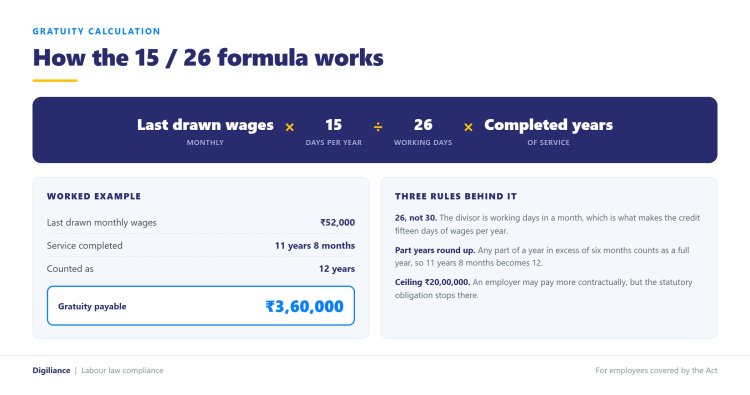
Gratuity = Last drawn wages × 15 ÷ 26 × Number of completed years of service
The 26 is the number of working days in a month, which is how the fraction produces fifteen days of wages for each completed year. Last drawn wages means the wages last drawn by the employee, and the service count includes any part of a year in excess of six months as a full year.
Worked through: an employee whose last drawn monthly wages are ₹52,000 and who has completed 11 years and 8 months of service is credited with 12 years. The calculation is 52,000 × 15 ÷ 26 × 12, which gives ₹3,60,000.
For employees not covered by the Act, where gratuity is paid under contract or policy, the conventional basis is fifteen days of wages for each completed year calculated on a thirty day month, and part years are not rounded up. The difference between the two bases is material over a long service period, so a company paying gratuity contractually to a non covered population should state which basis it uses in the policy document.
The ceiling and the tax position
The maximum gratuity payable under the statute is ₹20,00,000. An employer is free to pay more as a contractual or ex gratia amount, and many do for senior roles, but the statutory obligation stops at the ceiling.
Gratuity received by an employee is exempt from income tax up to the prescribed limit, with the exempt amount determined by the lower of the statutory calculation, the actual amount received and the prescribed ceiling. Anything above that is taxable in the employee's hands. Employers should confirm the current limit before finalising a high value settlement, since it has been revised more than once.
Change one: gratuity for fixed term employees after one year
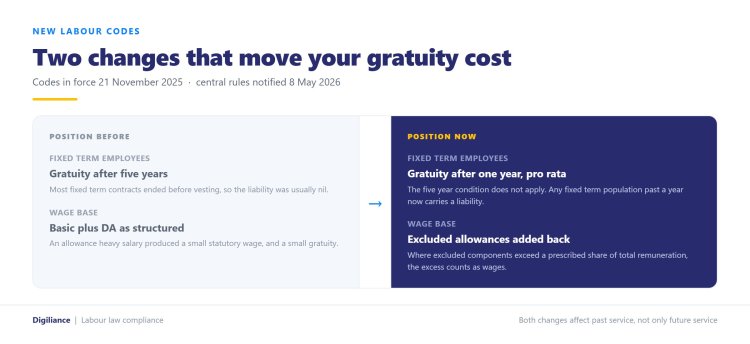
This is the change with the clearest cost impact. Under the Code on Social Security, a fixed term employee becomes eligible for gratuity on completion of one year of service, calculated on a pro rata basis, and the five year condition does not apply.
Fixed term employment is also required to carry the same hours of work, wages, allowances and other benefits as a permanent employee doing the same or similar work. The effect is that fixed term employment is no longer a cheaper form of engagement than permanent employment, which was the point of the reform.
For employers the practical consequences are immediate:
- Any workforce segment on fixed term contracts of a year or more now carries a gratuity liability that was previously nil.
- Project staffing models costed on the old assumption need to be repriced, including existing contracts where the cost sits with you rather than the client.
- Serial short contracts used to stay below a threshold do not work here, because the entitlement accrues pro rata from one year rather than cliff vesting at five.
- The actuarial valuation of gratuity liability must now include the fixed term population, which for a staffing heavy business can move the provision substantially.
Run the headcount first. Most finance teams discover that the number of people on fixed term contracts crossing a year is larger than they expected, because it includes renewals that were never reviewed as a cohort.
Change two: the revised definition of wages
The second change is less visible and in many companies larger. The labour codes use a common definition of wages across all four codes, which includes basic pay, dearness allowance and retaining allowance, and excludes a specified list of components such as house rent allowance, conveyance, overtime and most other allowances.
The critical part is the proviso. Where the excluded components exceed a prescribed share of total remuneration, the excess is added back and treated as wages. In practice this sets a floor under the wage base, so a salary structure built as a small basic plus a large bundle of allowances no longer produces a small statutory wage.
Gratuity is calculated on wages. So is provident fund, so is the basis for several other statutory payments. A company whose basic pay is thirty per cent of cost to company has been calculating gratuity on thirty per cent and will now calculate it on a materially higher figure. The liability rises on existing service as well as future service, because gratuity is computed on last drawn wages across the whole service period.
Three things follow:
- Recalculate the gratuity provision on the revised wage base, for the full covered population, not a sample.
- Review the salary structure before restructuring it. Raising basic pay increases gratuity and provident fund cost but is predictable. Leaving the structure alone and absorbing the add back is less predictable, because it moves with the allowance mix.
- Align the related heads. The same wage definition drives provident fund compliance and feeds into ESIC and leave encashment. Fixing them one at a time produces three inconsistent wage bases on the same payroll.
Payment timelines, nomination and forfeiture
Gratuity becomes payable as soon as it becomes due, and the employer must determine the amount and give notice to the employee and to the controlling authority whether or not an application has been made. The obligation to compute and offer the payment sits with the employer, not with the exiting employee. Where payment is delayed beyond the prescribed period, simple interest is payable on the amount for the period of delay.
Nomination is a standing obligation that is widely neglected. Each eligible employee should file a nomination, and it should be updated on marriage or on a change in family circumstances. An unresolved nomination turns a routine death claim into a dispute between claimants that the employer has to referee.
Gratuity may be forfeited in limited circumstances. Where the services of an employee have been terminated for any act, wilful omission or negligence causing damage or loss to the employer, gratuity may be forfeited to the extent of the damage or loss. Where termination is for riotous or disorderly conduct, any other act of violence, or an offence involving moral turpitude committed in the course of employment, gratuity may be forfeited wholly or partially. Forfeiture requires the termination to have been on those grounds and the employer to have followed a proper process. A forfeiture asserted for the first time at the exit interview will not survive review.
An employer action list for 2026
- Confirm the establishment is covered, including where headcount has since fallen below ten.
- Extract the fixed term population and identify everyone who has crossed or will cross one year of service.
- Recompute the gratuity provision on the revised wage definition, including the allowance add back.
- Decide the salary structure position deliberately rather than letting the add back decide it.
- Refresh nominations across the covered population and close the gaps.
- Check that exit processing computes and offers gratuity automatically rather than on employee application.
- Reconcile the gratuity wage base against the provident fund wage base so both use the same definition.
- Confirm whether central or state rules govern your establishment, since that decides which rules apply to filings.
Frequently asked questions
What are the new gratuity rules for fixed term employees?
Under the Code on Social Security, a fixed term employee is eligible for gratuity on completion of one year of service, calculated on a pro rata basis. The five year condition that applies to permanent employees does not apply to them.
How is gratuity calculated in India?
For employees covered by the Act, gratuity equals last drawn wages multiplied by 15, divided by 26, multiplied by the number of completed years of service. Any part of a year in excess of six months counts as a full year.
Is gratuity payable after four years and seven months?
Gratuity is payable for every completed year and for any part of a year in excess of six months, read together with the continuous service provisions. Courts in several jurisdictions have treated four years and 240 days in the fifth year as qualifying, and applying that reading consistently is the safer employer position.
What is the maximum gratuity payable?
The statutory maximum is ₹20,00,000. An employer may pay more as a contractual or ex gratia amount, but the statutory obligation stops at the ceiling.
Does the new wage definition increase gratuity cost?
For companies with an allowance heavy salary structure, yes. The codes add back excluded allowances beyond a prescribed share of total remuneration, which raises the wage base on which gratuity is computed, on past service as well as future service.
Can an employer forfeit gratuity?
Only in the limited circumstances set out in the statute, such as termination for an act causing damage or loss to the employer, for riotous or disorderly conduct or violence, or for an offence involving moral turpitude committed in the course of employment. The termination must have been on those grounds and a proper process must have been followed.
When must gratuity be paid?
It becomes payable as soon as it becomes due. The employer must determine the amount and give notice whether or not the employee applies, and simple interest is payable where payment is delayed beyond the prescribed period.
Getting the provision right before it is audited
Gratuity under the labour codes is not a policy question.
Digiliance maps gratuity alongside provident fund, ESIC and the rest of your statutory obligations against a single wage definition, so one structure change flows through every head rather than being corrected separately in each. See the labour law compliance platform, read the key highlights of the new labour codes, or review your wider position with our guide to statutory compliance in HR in India.