
Shops and establishment registration is the first labour law registration most businesses in India need, and the one most often left until a bank or a client asks for it. If you run a shop, an office, a restaurant, a warehouse, a clinic or a coworking desk with staff, your state's Shops and Establishments Act almost certainly applies, usually from the day you commence business rather than from the day you hire your tenth employee.
The complication is that there is no single national law. Each state has its own Act, its own deadline, its own fee slabs and its own renewal cycle. A company operating in four states holds four registrations on four different calendars. This guide sets out what is common across states, what differs, and how to build a registration position you can defend in an inspection.
What the Shops and Establishments Act actually governs
The Act is a state law regulating conditions of work in commercial establishments: working hours, intervals for rest, weekly holidays, overtime, leave, employment of women and young persons, conditions of termination, and the registers and notices the employer must keep. Registration is the entry point into that framework. The certificate is proof that the establishment exists on the labour department's record and has accepted those obligations.
Registration also does practical work outside the labour department. Banks ask for the certificate when opening a current account, payment gateways and marketplaces ask for it during onboarding, landlords and franchisors ask for it, and it is routinely requested in client and vendor diligence. Businesses that treat it as a formality tend to discover its importance at the point of a transaction, when the lead time to obtain it is the thing they do not have.
Who needs shops and establishment registration
The coverage test is the nature of the establishment, not its size. In most states a commercial establishment is covered whether or not it employs anyone beyond the proprietor, which is why a single person consultancy with a rented office is frequently within scope.
Commonly covered establishments include:
- Retail shops and showrooms
- Offices of companies, LLPs, partnerships and proprietorships
- Restaurants, cafes, hotels and other eating houses
- Warehouses, godowns and storerooms attached to a commercial business
- Theatres, amusement and entertainment establishments
- Clinics, diagnostic centres and other professional service premises, where the state Act covers them
Factories are the usual exception. Where a unit is registered under the Factories Act, that registration governs the working conditions and the shops and establishment registration is not duplicated. The dividing line is the nature of the activity at the premises, not the entity, so a manufacturer can hold a factory licence for the plant and a shops and establishment registration for its city head office.
A second point catches multi location businesses. Registration is premises specific. Opening a second branch in the same city is normally a separate registration, not an amendment to the first. Build this into your expansion checklist alongside professional tax registration, which follows the same premises logic in most states.
State-wise position: Acts, deadlines and renewal
The table below sets out the governing Act for the major states. Deadlines, fee slabs and renewal cycles are amended frequently and differ by employee count, so treat these as the starting point and confirm the current position on the state portal before you file.
| State | Governing Act | Registration position |
|---|---|---|
| Maharashtra | Maharashtra Shops and Establishments (Regulation of Employment and Conditions of Service) Act, 2017 | Registration required for establishments with ten or more workers, generally within 60 days of commencement. Establishments below ten workers file an online intimation instead of a registration |
| Karnataka | Karnataka Shops and Commercial Establishments Act, 1961 | Registration generally within 30 days of commencing work, certificate valid for five years. Changes and closure reportable within a short window |
| Delhi | Delhi Shops and Establishments Act, 1954 | The registration requirement has a history of being held in abeyance while the other provisions of the Act continue to apply. Confirm the current position with the Delhi Labour Department before concluding either way |
| Tamil Nadu | Tamil Nadu Shops and Establishments Act, 1947 | Registration through the state e-Sevai route. The online form is built around establishments with ten or more workers, which should not be read as a general exemption below that |
| Haryana | Punjab Shops and Commercial Establishments Act, 1958 as applicable to Haryana | Registration with the Labour Department, with periodic renewal |
| Uttar Pradesh | Uttar Pradesh Shops and Commercial Establishments Act, 1962 | Registration through the state labour portal, with a multi year validity period |
| Telangana | Telangana Shops and Establishments Act, 1988 | Registration with the Labour Department, with a periodic renewal cycle |
| West Bengal | West Bengal Shops and Establishments Act, 1963 | Registration with the Labour Department, with periodic renewal |
| Gujarat | Gujarat Shops and Establishments (Regulation of Employment and Conditions of Service) Act, 2019 | Registration or intimation depending on worker count, filed through the state route |
| Rajasthan | Rajasthan Shops and Commercial Establishments Act, 1958 | Registration generally within 30 days of commencing work, with fees varying by employee count |
Two patterns are worth pulling out of that table. First, the registration deadline in most states runs from the commencement of business, not from the date you cross a headcount. Waiting until you hire your first employee is the single most common way a business becomes late. Second, a growing number of states have split the obligation: a full registration above a worker threshold and a lighter online intimation below it. Maharashtra is the clearest example. Filing the wrong one of the two is treated as not filing at all.
Documents required for shops and establishment registration
The exact list is set by the state form, but the following covers most applications:
- PAN of the proprietor, firm, LLP or company
- Aadhaar or other identity proof of the proprietor, partner or authorised director
- Certificate of incorporation for a company or LLP, or the partnership deed for a firm
- Proof of the premises: registered lease deed, rent agreement or ownership document
- No objection certificate from the landlord where the premises are rented
- Recent photograph of the applicant and, in some states, a photograph of the premises or signboard
- Business details: trade name, nature of activity and date of commencement
- List of employees with names, designations and wages, where staff are employed
- Municipal property tax receipt or trade licence, where the state form requires it
The two items that hold up applications are the premises proof and the landlord no objection certificate. An unregistered rent agreement, a lease in the name of a director rather than the company, or a landlord who is slow to sign will each stall the file. Collect both before you start the application rather than part way through it.
The general process
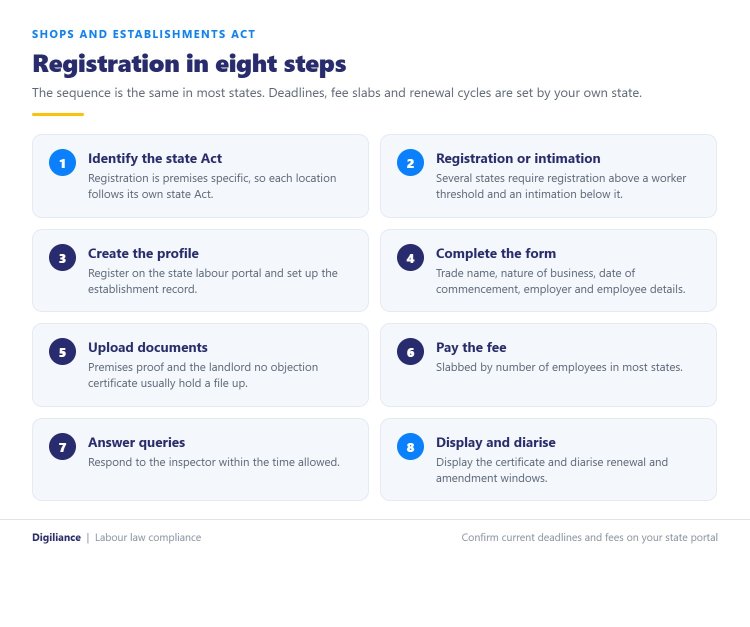
- Identify the state Act that applies to the premises and whether registration or intimation is the correct route for your worker count.
- Register on the state labour portal and create the establishment profile.
- Complete the application form with the trade name, nature of business, date of commencement, employer details and employee particulars.
- Upload the supporting documents in the prescribed formats and sizes.
- Pay the prescribed fee, which in most states is slabbed by number of employees.
- Track the application and respond to any query raised by the inspector within the time allowed.
- Download the registration certificate and display it at a conspicuous place in the establishment.
- Diarise the renewal date, if the state issues a time limited certificate.
Renewal, amendment and closure
Renewal cycles vary widely. Some states issue a certificate valid for a fixed number of years, some issue an annual certificate renewable by a fixed calendar date, and some issue a certificate with no renewal requirement at all. A business operating in several states will therefore have renewal dates scattered across the year, which is exactly the kind of obligation that lapses quietly.
Amendments are a second common gap. Most state Acts require the employer to notify a change within a short window, often fifteen days, where any of the registered particulars change. That includes a change of address, a change in the name of the establishment, a change of employer or manager, a change in the nature of business, and in several states a material change in the number of employees. Closure of the establishment must be notified too, and failing to do so leaves a live registration generating renewal defaults against a business that no longer operates at that address.
The practical control is a single register listing every establishment, its state, its Act, its certificate number, its validity date and the event based notifications it owes. That register sits naturally alongside the rest of your establishment compliance obligations.
Penalties for operating without registration
Penalties are set by each state Act and vary considerably. Maharashtra, as an illustration, provides for a fine of up to ₹1,00,000 for a contravention, with a further daily fine for a continuing contravention and a higher ceiling for a second or subsequent contravention. Other states prescribe lower fixed fines, and several provide for a daily penalty while the default continues.
Across states the pattern is consistent in two respects. The fine for late registration is usually modest, and the fine for continuing non compliance after notice is not. The second consistent point is that an unregistered establishment cannot produce the registers and notices the Act requires, so a single inspection typically generates a cluster of findings rather than one. The cost of regularising after an inspection is materially higher than the cost of registering on time.
How the labour codes affect shops and establishment registration
The four labour codes came into force on 21 November 2025, with the central rules notified on 8 May 2026. The codes consolidate twenty nine central labour laws, and the Occupational Safety, Health and Working Conditions Code in particular moves towards a single registration for establishments within its scope.
The Shops and Establishments Acts are state legislation and have not been repealed by the central codes. For the time being employers continue to register under the applicable state Act, while the codes govern the central law obligations layered on top. Where the central government is the appropriate government for an establishment, the central rules apply, and otherwise the state rules do, so the first question for any establishment is which set governs it. Our summary of the key highlights of the new labour codes sets out what has moved and what has not.
Frequently asked questions
Is shops and establishment registration mandatory for a one person business?
In most states the Act covers commercial establishments regardless of whether anyone is employed beyond the proprietor, so a single person office is typically within scope. The test is set by the state Act, so confirm it for your state.
How long does shops and establishment registration take?
Most states now process applications online and issue the certificate within a few working days of a complete submission. Delays are usually caused by incomplete premises proof or a missing landlord no objection certificate rather than by the department.
Do I need a separate registration for each branch?
Yes. Registration is premises specific in most states, so each branch or additional office generally requires its own registration rather than an amendment to the existing one.
Does a factory need shops and establishment registration?
A unit registered under the Factories Act is normally outside the shops and establishment framework for those premises. A separate office or warehouse operated by the same company may still need its own registration.
What happens if the registration is not renewed on time?
The consequence depends on the state Act and typically includes a fine, often with a daily component while the default continues. The practical consequence is that the establishment is operating without a valid certificate, which affects banking, onboarding and diligence.
Have the labour codes replaced the state Shops and Establishments Acts?
No. The Shops and Establishments Acts are state legislation and continue to apply. The four labour codes, in force since 21 November 2025, consolidate central labour laws and operate alongside them.
Keeping multi state registrations current
For a single location business, shops and establishment registration is a one time task with an occasional renewal. For a business operating across states it is a standing obligation with different deadlines, fee slabs, renewal cycles and amendment windows in each state, and no single authority reminding you of any of them.
Digiliance maps every establishment you operate to the applicable state Act, its registration status, validity dates and the event based notifications it owes, so renewals and amendments surface before they lapse rather than after. See the compliance checklist, or read the wider view in our guide to statutory compliance in HR in India.