
Payroll Compliance Services in India
Expert Payroll Compliance Services: Timely, Accurate Payments and Legal AdherenceA payroll run can be accurate to the rupee and still fail an inspection. A PF challan paid three days late, or LWF that was never deducted in one state, is enough. Digiliance payroll compliance services are set up to catch exactly those misses. Each month we check the PF, ESI, professional tax, labour welfare fund and TDS deductions, track every deposit against its due date, file the returns and keep your registers ready for an inspector. Your payroll team or software keeps running the payroll, and we look after the statutory filing calendar.
-
 Accurate preparation and filing of statutory returns
-
Challan preparation for PF, ESI, LWF, PTAX compliance
-
Adherence to state-specific minimum wage regulations
-
Timely submission of contributions to avoid penalties
-
Expert payroll compliance management for legal safety

What We Offer in Payroll Compliance Services
Comprehensive Payroll Compliance Solutions: Simplifying Tax, Deduction, and Legal Requirements
-
Payroll Records
Keep accurate salary registers to ensure legal compliance with employee earnings and deductions.
-
Salary Calculation
Calculate salaries accurately, factoring in overtime, bonuses, and minimum wage laws.
-
PF & ESI
Deduct and remit PF and ESI based on wages for government compliance.
-
Statutory Deductions
Deduct mandatory payments like PF, ESI, PT, LWF, and TDS to meet legal requirements.
-
Deductions Verification
Regularly verify and reconcile PF, ESI, and TDS deductions to prevent compliance issues.
-
Payments Reconciliation
Reconcile PF, ESI, and PT payments frequently to ensure accuracy and compliance.
-
TDS Filing
Ensure timely TDS filings based on income tax slabs to meet deadlines.
-
Statutory Returns
File timely returns for all payroll deductions to ensure legal compliance.
-
Audit Documentation
Maintain organized payroll records for easy audit access and inspection compliance.
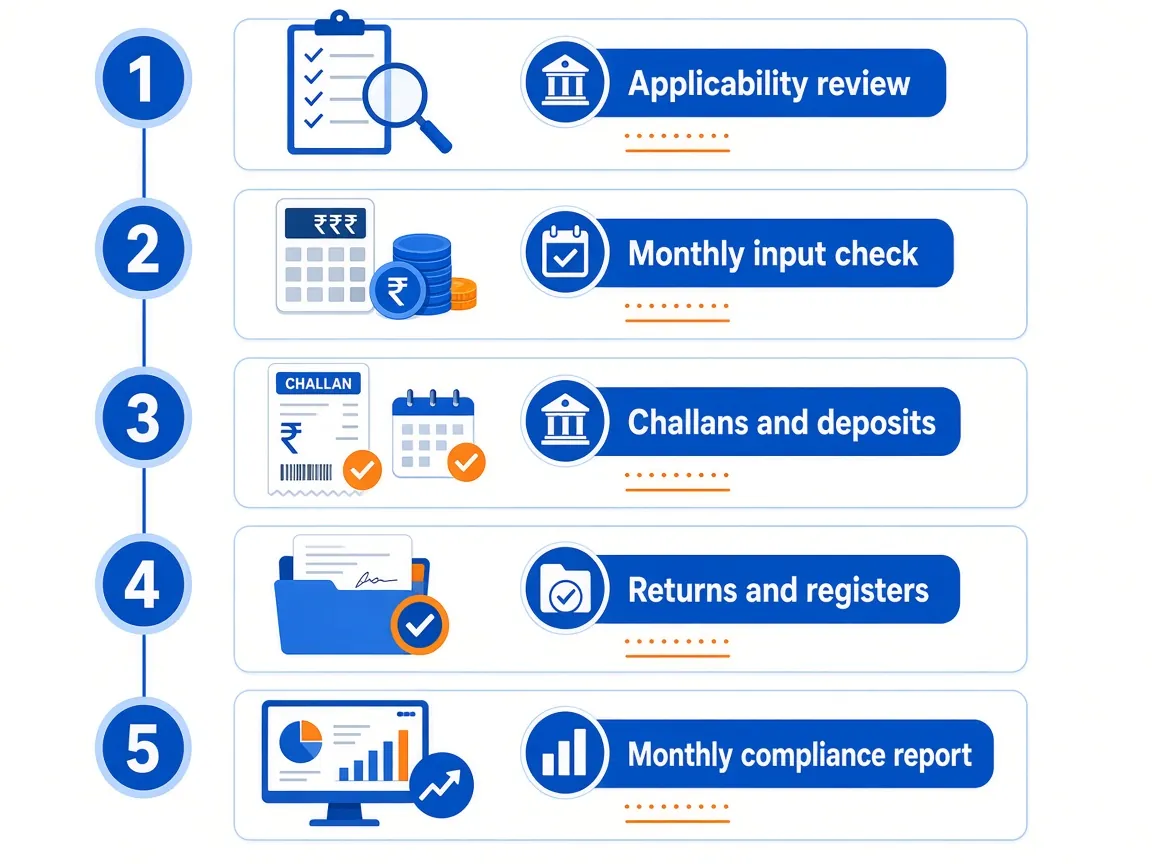
How our payroll compliance services work
- Applicability review. We identify which laws, state rates and registrations apply to each establishment and each category of employee.
- Monthly input check. Before payroll is run, we check wage components, state-wise minimum wages, overtime and deductions, including the wage definition under the Code on Wages, 2019.
- Challans and deposits. We prepare PF, ESI, professional tax and LWF challans and track each payment against its due date, covering PF compliance and ESI compliance.
- Returns and registers. We file statutory returns and maintain wage, attendance and deduction registers in the prescribed formats.
- Monthly compliance report. You receive a status report by location, with any exceptions and the action needed.
Monthly payroll compliance calendar
| Obligation | Due date | Notes |
|---|---|---|
| TDS on salaries (deposit) | 7th of the following month, and 30 April for March | Income Tax Rules |
| PF contribution and ECR | 15th of the following month | EPF scheme |
| ESI contribution | 15th of the following month | ESIC portal |
| Professional tax | Monthly, half-yearly or yearly, depending on the state | See state-wise professional tax rates |
| Labour welfare fund | Monthly, half-yearly or yearly, depending on the state | See the labour welfare fund guide |
| Quarterly TDS return (Form 24Q) | 31 July, 31 October, 31 January and 31 May | Income Tax Rules |
For every central and state due date in one place, see our compliance calendar.
Payroll compliance under the new labour codes
Since 21 November 2025, the Code on Wages, 2019 has used a single definition of wages, and its 50% rule changes the numbers for many salary structures. Take a monthly salary of ₹50,000 with a basic of ₹20,000 and ₹30,000 in excluded payments such as HRA and conveyance. The excluded part is 60% of pay, so the ₹5,000 above the 50% mark is added back, and wages for gratuity and other wage-linked benefits become ₹25,000 instead of ₹20,000. Structures with a low basic and large allowances are the ones to review first.
Our Strength
Statutory Laws
Ensure compliance with PF, ESI, TDS, PT, and LWF regulations.
Accurate deductions
Deductions for PF, ESI, TDS and professional tax are checked every month against current rates.
Compliance Management
Provide complete payroll solutions from salary calculation to return filing.
Filing Returns
Ensure timely filing of statutory returns to avoid penalties.
Audit Documentation
Maintain well-organized payroll records for easy audit access.
Compliance Monitoring
Stay updated on labour law changes, ensuring ongoing legal compliance.
Who these services are for
Companies without a dedicated compliance team.
Employers in several states, each with its own professional tax and labour welfare fund rules.
Companies moving salary structures to the new wage definition.
Businesses that outsource payroll processing and want someone independent to check the statutory side.
Frequently Asked Questions
They cover the statutory side of payroll: deducting PF, ESI, professional tax, LWF and TDS correctly, depositing them on time, and filing the returns and registers that go with them. The provider checks every payroll cycle and tracks the due dates, so late-payment interest, damages and penalties do not build up.
Payroll compliance refers to the legal requirement of adhering to laws regarding employee salaries, tax deductions including professional tax, benefit contributions such as PF, ESI and LWF, and statutory filings. Non-compliance can result in penalties and legal consequences.
Payroll compliance is crucial to avoid interest on delayed payment, penalties, fines, legal risks and damage to business reputation. It ensures accurate tax deductions, proper employee benefits, and compliance with labour laws and tax regulations, including TDS and PF contributions.
Key payroll compliance requirements include timely salary payments, employee benefit contributions (PF, ESI), accurate tax deductions (TDS), maintaining proper records, and filing statutory returns within deadlines.
To ensure payroll compliance, maintain accurate records, stay updated on tax laws, contribute to employee welfare funds (PF, ESI), and file statutory returns on time. You can also partner with a payroll compliance service provider for expert support.
Non-compliance with payroll laws can lead to fines, penalties, legal issues and damage to reputation. Businesses may face audits, legal action, and the requirement to pay outstanding dues, including unpaid taxes and employee benefits.



