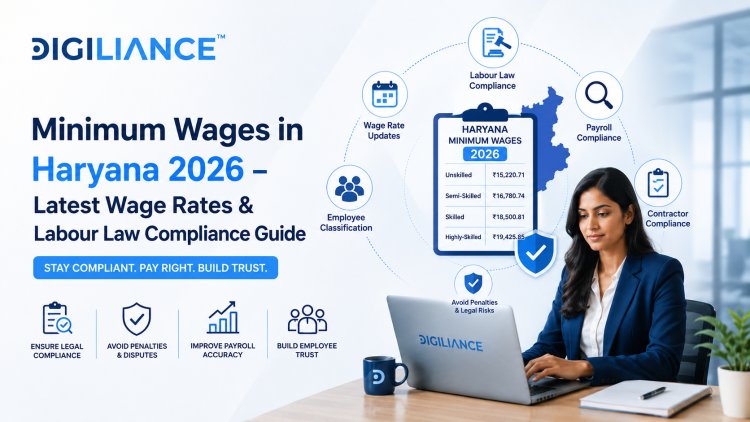
The Government of Haryana has revised the minimum wages in Haryana for all covered employments with effect from 1 April 2026. The revised rates were notified by the Haryana Labour Department through Notification No. 2/25/26-2 Lab., dated 9 April 2026, issued under Section 8(3) of the Code on Wages, 2019.
The revised Haryana minimum wages 2026 are particularly important for employers, HR teams, payroll professionals, contractors and businesses because minimum wage compliance directly affects salary processing, employee classification, overtime, contractor payments and overall Haryana labour law compliance.
This article explains the latest Haryana wage rates 2026, worker categories, payroll implications, overtime, contract labour responsibilities and the key steps employers should take to remain compliant.
Update: As of September 2026, the rates notified with effect from 1 April 2026 are the latest Haryana minimum wage rates verified for this article. Employers should check for any subsequent government notification before processing wages for a later period.
Latest Minimum Wages in Haryana 2026
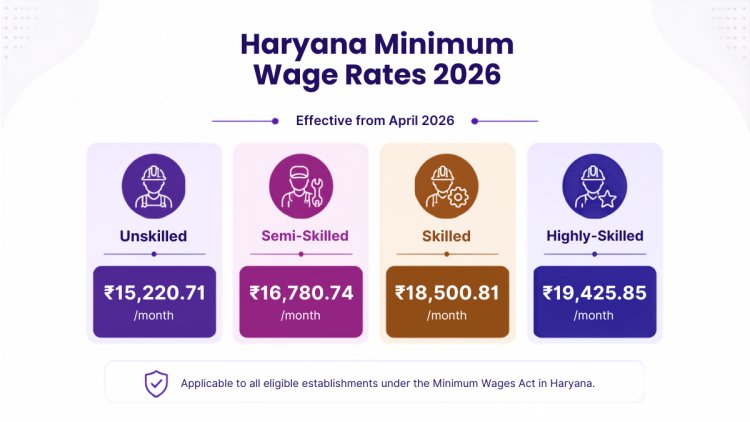
The revised rates are effective from 1 April 2026 and apply to the covered employments and categories specified in the Haryana notification.
|
Worker Category |
Minimum Wage Per Month |
Minimum Wage Per Day |
|---|---|---|
|
Unskilled |
₹15,220.71 |
₹585.41 |
|
Semi-Skilled |
₹16,780.74 |
₹645.41 |
|
Skilled |
₹18,500.81 |
₹711.56 |
|
Highly-Skilled |
₹19,425.85 |
₹747.14 |
For complete details of the revised minimum wage rates, employers can download the Haryana Minimum Wage Notification – April 2026.
? Download Haryana Minimum Wage Notification 2026 (PDF)
The revised Haryana minimum wage rates were notified by the Haryana Labour Department through Notification No. 2/25/26-2 Lab., dated 9 April 2026, under Section 8(3) of the Code on Wages, 2019. The revised rates are effective from 1 April 2026.
Employers should refer to the official government notification for the complete legal provisions and verify whether any subsequent notification has revised the applicable rates.
Haryana Minimum Wage Notification 2026: Key Details
-
State: Haryana
-
Notification No.: 2/25/26-2 Lab.
-
Notification Date: 9 April 2026
-
Effective Date: 1 April 2026
-
Legal basis: Section 8(3), Code on Wages, 2019
-
Coverage: Covered employments, establishments, factories and contract labour
-
Worker categories: Unskilled, Semi-Skilled, Skilled and Highly-Skilled
-
Brick kilns: Rates to be notified separately
The notification replaced the earlier minimum wage rates that had been fixed/revised under the previous Haryana notification dated 21 October 2015.
What Are Minimum Wages in Haryana?
Minimum wages are the legally prescribed wage floor that employers must follow for covered workers. The purpose is to ensure that employees are not paid below the applicable minimum rate for their category of work.
Under the 2026 Haryana notification, the applicable rate depends on the worker's skill category. Employers therefore need to look beyond the employee's job title and assess whether the actual work and skill requirements correspond to the applicable category.
The revised rates are notified as basic minimum rates of wages. Importantly, the Haryana notification states that these rates are not permitted to be segregated into components in the form of allowances by the employer.
Haryana Minimum Wage Rates by Worker Category
1. Unskilled Workers
The minimum wage for an unskilled worker is:
₹15,220.71 per month or ₹585.41 per day.
This category generally covers work that does not require specialised technical knowledge or a higher level of skill.
However, employers should not classify a worker as unskilled simply because the job title contains terms such as “helper” or “general worker.” Actual duties, skills and experience should be considered.
2. Semi-Skilled Workers
The minimum wage for a semi-skilled worker is:
₹16,780.74 per month or ₹645.41 per day.
Semi-skilled work generally involves some degree of practical knowledge, training or experience beyond basic unskilled work.
3. Skilled Workers
The minimum wage for a skilled worker is:
₹18,500.81 per month or ₹711.56 per day.
Skilled roles generally require technical knowledge, training, experience or specialised abilities.
4. Highly-Skilled Workers
The minimum wage for a highly-skilled worker is:
₹19,425.85 per month or ₹747.14 per day.
These roles generally involve a higher degree of technical expertise, specialised knowledge or responsibility.
Employers should maintain proper documentation supporting the classification used for payroll purposes.
Are the Haryana Minimum Wages the Same Across Gurugram, Faridabad and Other Districts?
The April 2026 notification specifies the revised rates for the State of Haryana according to skill category rather than providing separate rates for Gurugram, Faridabad or other districts.
Therefore, employers should determine the applicable rate based primarily on the relevant worker category and employment, rather than assuming that a different minimum wage applies simply because the establishment is located in Gurugram, Faridabad or another Haryana district.
How Should Employers Implement Haryana Minimum Wages 2026?
Updating minimum wages is not simply a matter of changing one number in payroll software. Employers should review the entire wage and compliance structure.
Step 1: Identify Employees Covered by the Revision
Prepare a list of employees and workers whose wages are subject to the applicable Haryana minimum wage requirements.
Step 2: Review Skill Classification
Check whether each employee has been classified correctly as unskilled, semi-skilled, skilled or highly-skilled.
Step 3: Compare Existing Wages
Compare the applicable wage structure with the revised minimum wage rate effective from 1 April 2026.
Step 4: Update Payroll
Update payroll software and salary-processing systems with the applicable rates. Payroll teams should also review related payroll compliance requirements to ensure that wage calculations, deductions, salary records and statutory processes remain aligned.
Step 5: Review Attendance and Wage Records
Ensure attendance, working days, wage records and deductions are correctly maintained.
Step 6: Review Contractor Payments
Where manpower is supplied through contractors or service providers, verify that the applicable minimum wages are being paid.
Step 7: Maintain Documentation
Keep records of wage revisions, employee classification, payroll changes and contractor verification for compliance reviews and inspections.
How Is the Daily Minimum Wage Calculated in Haryana?
The Haryana notification specifically provides a monthly and daily rate.
For calculation of the daily wage, the notification states that the monthly wage is divided by 26 days. For deductions, the notification states that the monthly wage is divided by 30 days, unless otherwise prescribed by the appropriate government.
For example, the notified skilled-worker rates are:
-
Monthly minimum wage: ₹18,500.81
-
Daily minimum wage: ₹711.56
Employers should use the figures and calculation methodology specified by the applicable notification rather than independently replacing the notified rates with rounded figures.
Can Minimum Wages Be Split Into Basic Pay and Allowances?
This is an important point for payroll teams.
The April 2026 Haryana notification states that the notified minimum rates are basic rates of minimum wages and are not permitted to be segregated into components in the form of allowances by the employer.
Therefore, employers should review salary structures carefully before attempting to meet the minimum wage through artificial restructuring of the notified minimum rate.
Overtime and Haryana Minimum Wage Compliance
Minimum wage compliance should also be reviewed alongside overtime.
Section 14 of the Code on Wages, 2019 provides that where an employee whose minimum rate of wages has been fixed works beyond the hours constituting a normal working day, overtime must be paid at a rate not less than twice the normal rate of wages.
Employers should therefore maintain accurate records of:
-
Working hours
-
Attendance
-
Overtime hours
-
Overtime payments
-
Wage calculations
-
Salary slips
The exact calculation should be made with reference to the applicable wage structure and working-hour requirements rather than using a generic hourly calculation for every employee.
Minimum Wage Compliance for Contract Labour in Haryana
Contract labour is an important part of contractor compliance in Haryana, particularly where businesses engage workers through contractors or manpower service providers.
The April 2026 notification specifically covers contract labour and states that where workers in the covered categories are engaged through a contractor or service provider, the occupier or principal employer is responsible for ensuring payment of the applicable minimum wages by the contractor or service provider.
This means businesses should not treat contractor wage compliance as entirely outside their responsibility.
Principal employers should periodically verify:
-
Contractor wage registers
-
Attendance records
-
Salary payment records
-
Minimum wage calculations
-
Overtime payments
-
PF and ESI records, where applicable
-
Contractor registration/licence documents, where applicable
-
Employee deployment records
A regular contractor compliance review can help identify wage discrepancies before they become larger statutory issues.
What About Trainees and Apprentices?
The Haryana notification makes an important distinction between trainees and apprentices.
Trainees
The notification states that a trainee should be paid 75% of the wages applicable to the relevant category, but the amount cannot be lower than the minimum wage applicable to an unskilled worker. The training period cannot exceed one year.
Apprentices
Apprentices appointed under the Apprentices Act, 1961 are governed by that Act, as specifically stated in the Haryana notification.
Employers should therefore avoid treating every trainee or apprentice as an ordinary employee or applying a single wage rule without checking the applicable legal framework.
Equal Wages for Men and Women
The Haryana notification clearly states that there shall be no difference between wages for men and women workers.
Employers should therefore ensure that employees performing comparable work requiring similar skills and experience are not paid differently merely on the basis of gender.
This is also consistent with the broader equal-pay principle under the Code on Wages, 2019.
How the Revised Minimum Wages Affect Payroll
The revision can have a direct impact on payroll and workforce costs.
Salary Structures
Businesses may need to revise salary structures where employees are receiving less than the applicable minimum wage.
Overtime Costs
Since overtime is linked to the normal wage rate, changes in wage levels can affect overtime expenditure.
Contractor Costs
Businesses using outsourced manpower may see changes in contractor billing because contractors must account for applicable wage obligations.
Statutory Contributions
Changes in wage structures may also affect statutory contribution calculations wherever the relevant wage components form the basis for those contributions.
Budgeting
Finance and HR teams should review labour budgets and workforce costs after implementing the revised rates.
Common Minimum Wage Compliance Mistakes
Businesses should avoid the following common mistakes:
1. Using Old Wage Rates
Continuing to use pre-April 2026 wage rates can result in underpayment.
2. Incorrect Skill Classification
Placing an employee in a lower category without considering actual work and skill requirements can create compliance risk.
3. Splitting the Minimum Wage Into Allowances
The Haryana notification specifically restricts segregation of the notified minimum rate into allowance components.
4. Ignoring Contract Workers
Principal employers should verify contractor compliance instead of assuming that the contractor alone carries the entire responsibility.
5. Incorrect Overtime Calculations
Overtime should be calculated according to the applicable legal requirements, with the Code on Wages providing a minimum rate of twice the normal rate for covered work beyond normal working hours.
6. Poor Record Keeping
Incomplete attendance, wage, overtime or contractor records can make it difficult to demonstrate compliance during an inspection.
Haryana Minimum Wage Compliance Checklist for Employers
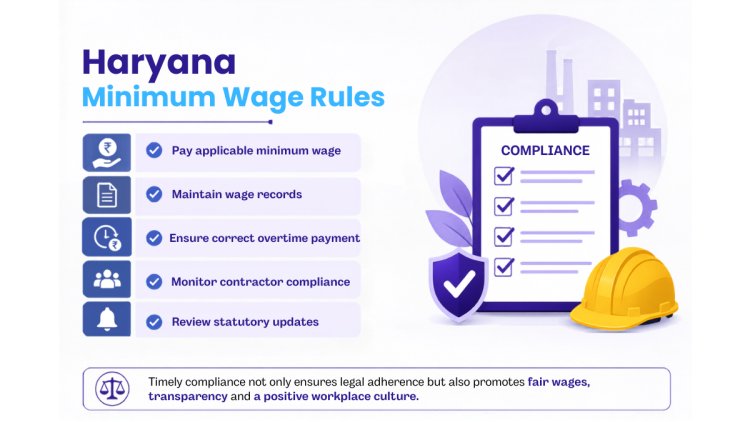
Businesses can also use a structured labour compliance checklist to review applicable wage, statutory and documentation requirements across their establishments.
-
Review the latest Haryana wage notification.
-
Identify all employees and workers covered by the applicable rates.
-
Verify skill classification.
-
Compare existing wages with the revised minimum rates.
-
Update payroll systems.
-
Review salary structures.
-
Verify daily/monthly wage calculations.
-
Review overtime calculations.
-
Check contractor wage payments.
-
Maintain attendance and wage records.
-
Issue accurate wage slips.
-
Maintain supporting compliance documents.
-
Review wage compliance periodically.
For organisations with a large workforce, regular payroll and labour-law audits can help identify discrepancies early.
What Employers Should Do Now
For organisations managing multiple employees, locations and contractors, labour law compliance management software can help centralise compliance records, statutory documents, wage-related requirements and compliance tracking.
The April 2026 wage revision should be treated as an ongoing payroll and compliance requirement rather than a one-time update.
HR and payroll teams should:
Review → Classify → Calculate → Update → Verify → Document
This approach helps ensure that employee wages, overtime, contractor payments and supporting records remain aligned with the applicable Haryana requirements.
Businesses should also monitor future Haryana Labour Department notifications because minimum wage rates can be revised through subsequent government notifications.
Key Takeaways: Minimum Wages in Haryana 2026
The most important points for employers are:
-
The revised rates are effective from 1 April 2026.
-
The notification was issued on 9 April 2026.
-
Unskilled workers: ₹15,220.71/month.
-
Semi-skilled workers: ₹16,780.74/month.
-
Skilled workers: ₹18,500.81/month.
-
Highly-skilled workers: ₹19,425.85/month.
-
Daily rates are ₹585.41, ₹645.41, ₹711.56 and ₹747.14 respectively.
-
The notification covers applicable establishments, factories and contract labour.
-
Brick-kiln wage rates are to be notified separately.
-
The notified minimum rates cannot be segregated into allowance components by the employer.
-
The notification provides equal wages for men and women workers.
-
Principal employers have responsibility for ensuring applicable minimum wages are paid by contractors/service providers.
-
Trainees are subject to the specific 75% rule, subject to the unskilled minimum floor.
-
Apprentices under the Apprentices Act are governed separately.
-
Monthly wages are divided by 26 for calculating the daily wage, while deductions use a 30-day basis as specified in the notification.
-
Overtime under Section 14 of the Code on Wages is payable at not less than twice the normal rate for covered employees working beyond normal working hours.
Frequently Asked Questions
What are the minimum wages in Haryana in 2026?
Effective from 1 April 2026, the minimum wages are ₹15,220.71 per month for unskilled workers, ₹16,780.74 for semi-skilled workers, ₹18,500.81 for skilled workers and ₹19,425.85 for highly-skilled workers.
When did the Haryana minimum wage rates 2026 become effective?
The revised rates became effective from 1 April 2026 under Haryana Labour Department Notification No. 2/25/26-2 Lab., dated 9 April 2026.
What is the minimum wage for an unskilled worker in Haryana?
The notified minimum wage for an unskilled worker is ₹15,220.71 per month or ₹585.41 per day.
What is the minimum wage for a skilled worker in Haryana?
The notified minimum wage for a skilled worker is ₹18,500.81 per month or ₹711.56 per day.
Do Haryana minimum wages apply to contract labour?
Yes. The April 2026 notification covers contract labour. It also states that the occupier or principal employer is responsible for ensuring that applicable minimum wages are paid by the contractor or service provider.
Are minimum wages different in Gurugram and Faridabad?
The April 2026 notification provides the rates for Haryana according to worker category and does not specify separate minimum wage rates for Gurugram or Faridabad.
How is the daily minimum wage calculated in Haryana?
The notification states that monthly wages are divided by 26 days for calculating the per-day wage. For deductions, monthly wages are divided by 30 days, unless otherwise prescribed.
What is the overtime rate under the Code on Wages?
Section 14 of the Code on Wages, 2019 provides that covered employees working beyond the normal working day must receive overtime at a rate not less than twice the normal rate of wages.
Conclusion
The revision of minimum wages in Haryana 2026 has important implications for payroll, HR and labour compliance. Employers should not rely on older wage rates or informal salary calculations when processing wages after 1 April 2026.
A proper compliance review should cover employee classification, wage structures, payroll calculations, overtime, contractor payments and supporting records.
For businesses operating in Haryana, keeping payroll aligned with the latest government notifications is an important part of effective minimum wage compliance, payroll compliance and Haryana labour law compliance.
Note: Minimum wage rates and labour-law requirements can change through subsequent government notifications. Employers should verify the latest applicable notification before making compliance decisions.