POSH Act 2013 compliance is an important legal responsibility for employers in India. The Sexual Harassment of Women at Workplace (Prevention, Prohibition and Redressal) Act, 2013, commonly known as the POSH Act, establishes a framework for preventing sexual harassment at the workplace and providing a mechanism for addressing complaints.
For employers, POSH compliance is more than simply creating a policy document. Organisations need to establish the appropriate Internal Committee, communicate the POSH policy, conduct awareness programmes, provide orientation to committee members, maintain confidentiality, follow inquiry timelines and complete applicable reporting requirements.
This guide explains the key POSH Act 2013 compliance requirements, employer responsibilities, complaint and inquiry timelines, documentation requirements and consequences of non-compliance.
What Is POSH Act 2013 Compliance?
POSH compliance refers to the measures taken by an organisation to prevent sexual harassment at the workplace and establish a proper mechanism for receiving and addressing complaints.
The POSH Act covers sexual harassment of women at the workplace and also covers certain situations connected with employment. The definition of workplace under the Act includes places visited by employees during the course of employment and employer-provided transportation, among other situations.
For employers, a practical POSH compliance framework should include:
- Proper constitution of the Internal Committee, where applicable
- A written POSH policy
- Employee awareness programmes
- Orientation and training for Internal Committee members
- Clearly communicated complaint channels
- A defined inquiry process
- Confidentiality controls
- Proper documentation and record keeping
- Annual reporting requirements
- Display of required information at the workplace
Why Is POSH Compliance Important for Businesses?
POSH compliance helps organisations establish a formal framework for preventing and addressing workplace sexual harassment.
A properly implemented POSH framework can help businesses:
- Meet statutory requirements
- Provide employees with a defined complaint mechanism
- Improve awareness of appropriate workplace behaviour
- Establish a structured complaint and inquiry process
- Maintain required records
- Protect confidentiality during proceedings
- Identify compliance gaps through periodic reviews
- Reduce legal and operational risks associated with non-compliance
POSH compliance should therefore be treated as an ongoing compliance responsibility rather than a one-time HR activity.
Businesses that need support with broader statutory and workplace requirements can also explore HR Labour Compliance Services for professional compliance management support.
Understanding Sexual Harassment Under the POSH Act
The POSH Act prohibits sexual harassment of women at the workplace.
Sexual harassment may include unwelcome behaviour such as:
- Physical contact and advances
- A demand or request for sexual favours
- Sexually coloured remarks
- Showing pornography
- Other unwelcome physical, verbal or non-verbal conduct of a sexual nature
The Act also recognises certain circumstances connected with such conduct. These may include implied or explicit promises of preferential treatment, threats related to employment, interference with work, creation of an intimidating or hostile work environment, or humiliating treatment affecting health or safety.
Employers should ensure that employees understand what may constitute sexual harassment and know how to report concerns through the appropriate mechanism.
Key Legal Requirements Under the POSH Act 2013
1. Constitute an Internal Committee
An employer is required to constitute an Internal Committee (IC) through a written order at workplaces covered by the statutory requirement.
The Internal Committee must include:
- A woman employed at a senior level as the Presiding Officer
- At least two employee members
- One external member from an NGO/association committed to the cause of women or a person familiar with issues relating to sexual harassment
- At least half of the total members must be women
The Act also provides for a Local Committee for establishments where an Internal Committee cannot be constituted because there are fewer than 10 workers, and for certain complaints against the employer.
The IC should not exist only on paper. Employers should ensure that its constitution, member details and related documentation are properly maintained.
2. Develop and Communicate a POSH Policy
Employers should maintain a clear and accessible POSH policy explaining the organisation's approach to preventing and addressing sexual harassment.
The policy should cover:
- What constitutes sexual harassment
- Who can make a complaint
- How a complaint can be submitted
- Contact details or reporting channels
- Role of the Internal Committee
- Complaint and inquiry procedure
- Confidentiality requirements
- Possible consequences of misconduct
- Responsibilities of employees
The policy should be communicated to employees and made accessible to them.
3. Conduct Employee Awareness and POSH Training
Employers are required to organise workshops and awareness programmes for employees relating to the prevention of sexual harassment.
Employee awareness programmes should explain:
- Appropriate workplace behaviour
- Workplace boundaries
- What may constitute sexual harassment
- How to raise a complaint
- Whom an employee can approach
- The role of the Internal Committee
- Confidentiality requirements
- Possible consequences of misconduct
The objective should not be limited to completing a training session. Employees should actually understand the organisation's reporting mechanism and their responsibilities.
4. Provide Orientation to Internal Committee Members
Internal Committee members have an important role in handling complaints and conducting inquiries.
They should understand:
- POSH Act requirements
- Complaint handling procedures
- Inquiry procedures
- Principles of natural justice
- Confidentiality requirements
- Documentation
- Evidence and witness handling
- Preparation of inquiry findings
- Recommendations and follow-up actions
The Act places a duty on employers to provide necessary facilities and support to the Internal Committee for dealing with complaints and conducting inquiries.
5. Establish a Clear Complaint and Redressal Process
Employees should have a clear and accessible mechanism for submitting complaints.
Under Section 9, a complaint is generally required to be made in writing within three months from the date of the incident or, in the case of a series of incidents, within three months from the date of the last incident.
The Internal Committee or Local Committee may extend this period by up to another three months if it is satisfied that circumstances prevented the woman from filing the complaint within the original period, with reasons recorded in writing.
Organisations should clearly communicate:
- Where a complaint can be submitted
- Whom an employee can approach
- Applicable complaint timelines
- How the inquiry will be conducted
- Confidentiality requirements
- Relevant documentation requirements
6. Complete the Inquiry Within 90 Days
Where an inquiry is conducted, the Internal Committee or Local Committee is required to complete the inquiry within 90 days.
After completing the inquiry, the Committee must provide its findings to the employer or District Officer within the applicable statutory timeline. The employer or District Officer is then required to act on the recommendations within the period prescribed by the Act.
Maintaining an internal timeline tracker can help organisations monitor important stages of the complaint and inquiry process.
7. Maintain Confidentiality and Proper Records
Confidentiality is a critical part of POSH proceedings.
The Act restricts publication or communication of the contents of a complaint, identities and addresses of the parties and witnesses, and information relating to conciliation, inquiry proceedings, recommendations and action taken.
Organisations should therefore maintain secure records of:
- Complaints received
- Inquiry proceedings
- Evidence and relevant documents
- Committee findings
- Recommendations
- Actions taken
- Annual reporting information
Access to sensitive information should be limited to authorised persons.
8. Meet Annual Reporting Requirements
The Internal Committee or Local Committee is required to prepare an annual report for each calendar year and submit it to the employer and District Officer as prescribed under the Act.
The report includes prescribed information regarding complaints received and disposed of, among other details.
Employers also have obligations under Section 22 regarding information on cases filed and their disposal in the organisation's annual report, or communication of such information to the District Officer where an annual report is not required.
POSH Compliance Checklist for Employers
Businesses can use the following checklist for an internal POSH compliance review:
| Compliance Area | What Employers Should Verify |
|---|---|
| Internal Committee | Proper constitution and written order |
| IC Composition | Presiding Officer, employee members and external member |
| IC Gender Composition | At least half of total members are women |
| POSH Policy | Written, communicated and accessible |
| Employee Training | Awareness programmes conducted |
| IC Orientation | Members properly oriented |
| Complaint Process | Clear reporting mechanism |
| Inquiry | Statutory timelines tracked |
| Confidentiality | Complaint and inquiry information protected |
| Records | Required documentation maintained securely |
| Annual Report | Applicable reporting requirements completed |
| Workplace Display | Required information and IC details displayed |
Businesses can also use a compliance checklist to systematically track important compliance requirements.
Consequences of Non-Compliance With the POSH Act 2013
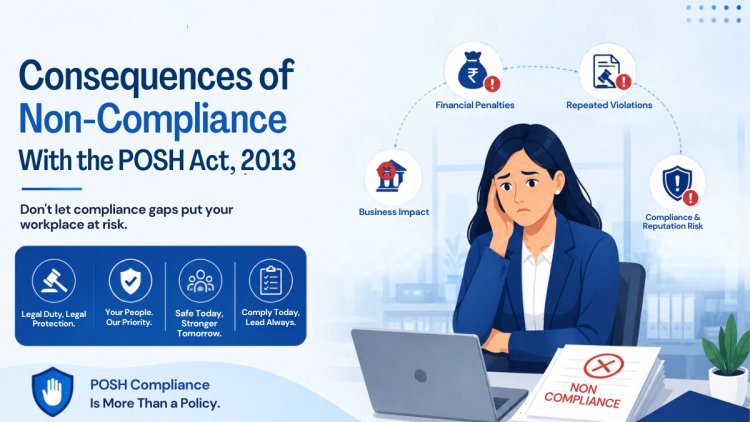
Non-compliance with the POSH Act can result in statutory penalties.
Under Section 26, specified non-compliance, including failure to constitute the Internal Committee or failure to take action as required under specified provisions, may attract a fine of up to ₹50,000.
For subsequent convictions for the same offence, the Act provides for a higher punishment, including twice the punishment that could be imposed for the first conviction, subject to the statutory provisions. There can also be consequences concerning the licence, registration or approval of the organisation, where applicable.
Therefore, businesses should treat POSH compliance as an ongoing governance and compliance responsibility rather than simply maintaining a policy document.
Common POSH Compliance Challenges for Businesses
HR teams may face several practical challenges while managing POSH compliance, including:
- Incorrect constitution of the Internal Committee
- Outdated POSH policy
- Employees being unaware of reporting channels
- Inadequate orientation of IC members
- Incomplete documentation
- Delays in inquiry proceedings
- Weak confidentiality controls
- Missed reporting requirements
- Lack of periodic compliance review
A structured compliance process can help organisations identify gaps and maintain the required documentation and timelines.
Best Practices for POSH Compliance
Businesses should consider the following practices:
- Review the POSH policy periodically.
- Verify that the Internal Committee remains properly constituted.
- Conduct employee awareness programmes at appropriate intervals.
- Provide appropriate orientation to IC members.
- Keep complaint and inquiry records secure.
- Track statutory timelines carefully.
- Maintain confidentiality throughout the proceedings.
- Review annual reporting requirements.
- Keep employees informed about reporting channels.
- Periodically review the organisation's POSH compliance framework.
For businesses managing multiple statutory requirements, labour law compliance management can help centralise compliance tracking, documentation and monitoring.
How Digiliance Helps Businesses With Compliance Management
Managing compliance manually can become difficult when HR teams need to track multiple requirements, documents, deadlines and locations.
Digiliance provides compliance management solutions that help businesses centralise compliance information, track activities and maintain relevant documentation.
Businesses can use compliance management tools for:
- Centralised compliance tracking
- Compliance checklists
- Document management
- Compliance monitoring
- Regulatory updates
- Reporting and record management
- Multi-location compliance visibility
Need help managing workplace and labour compliance? Talk to the Digiliance team.
Conclusion
POSH Act 2013 compliance is an ongoing responsibility for employers. It involves much more than creating a POSH policy or conducting a training session once a year.
Organisations should maintain an appropriately constituted Internal Committee, provide accessible complaint channels, conduct employee awareness programmes, orient IC members, follow inquiry timelines, protect confidentiality, maintain proper records and complete applicable reporting requirements.
A structured POSH compliance process can help businesses meet their statutory responsibilities while creating a safer and more respectful workplace.
Frequently Asked Questions
1. What is POSH Act 2013 compliance?
POSH Act 2013 compliance refers to the measures an employer takes to prevent sexual harassment at the workplace and establish a mechanism for receiving and addressing complaints under the Act.
2. Is an Internal Committee mandatory?
Employers are required to constitute an Internal Committee at workplaces covered by the statutory requirement. The Act also provides for a Local Committee where an Internal Committee cannot be constituted because there are fewer than 10 workers and for certain complaints against the employer.
3. Who should be part of the Internal Committee?
The Internal Committee must include a woman as Presiding Officer at a senior level, at least two employee members and one external member meeting the requirements of the Act. At least half of the total members must be women.
4. Is POSH training mandatory for employees?
The Act requires employers to organise workshops and awareness programmes for employees and orientation programmes for Internal Committee members.
5. How long does a POSH inquiry take?
The inquiry is required to be completed within 90 days.
6. Is annual POSH reporting mandatory?
Yes. The Internal Committee or Local Committee is required to prepare an annual report for each calendar year as prescribed under the Act. Employers also have reporting obligations under Section 22.
7. What is the penalty for POSH non-compliance?
Specified non-compliance under Section 26 may attract a fine of up to ₹50,000. Subsequent convictions can result in higher statutory punishment and other consequences provided under the Act.
8. How can businesses improve POSH compliance?
Businesses should maintain a properly constituted Internal Committee, keep their POSH policy updated, conduct awareness programmes, provide orientation to IC members, maintain confidentiality, track inquiry timelines, maintain records and complete applicable reporting requirements.
Government Reference
For detailed legal provisions, refer to the official Sexual Harassment of Women at Workplace (Prevention, Prohibition and Redressal) Act, 2013 available through India Code.
Sexual Harassment of Women at Workplace Act, 2013 — India Code