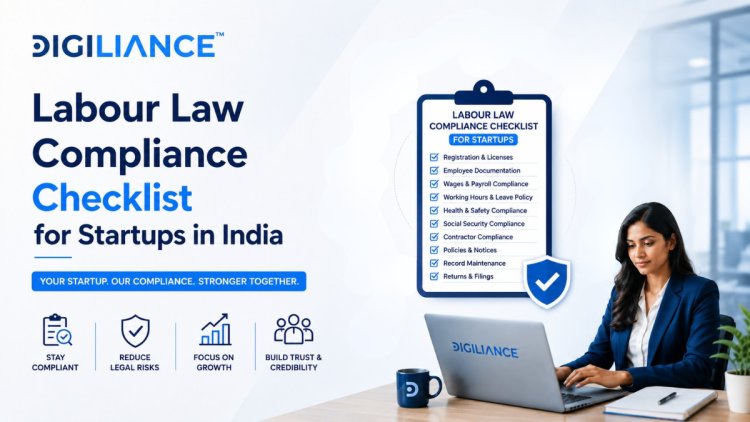
Starting a business requires founders to focus on products, customers, hiring, funding and growth. But once a startup begins employing people or engaging contractors, labour and HR compliance becomes an important part of running the business.
A labour law compliance checklist helps startups identify applicable registrations, statutory contributions, employee records, workplace requirements and recurring obligations.
Compliance is not only a legal necessity; it also supports better governance, accurate payroll, employee confidence and smoother business operations.
This guide provides a practical labour law compliance checklist for startups in India, covering key registrations, applicability thresholds, payroll, workplace requirements, contractor compliance and compliance audits.
Important: Labour-law applicability can vary based on the state, establishment type, industry, employee count, wages and other factors. The checklist below is a practical starting point and should be mapped against the startup's actual business and workforce structure.
Labour Law Compliance Checklist for Startups
Use this checklist to identify the key compliance areas that a startup should review.
|
Compliance Area |
Applicability / Trigger |
What to Check |
Frequency |
|---|---|---|---|
|
Employee Documentation |
From hiring |
Appointment letters, employee records and employment terms |
At joining + ongoing |
|
Shops & Establishments |
State-specific |
Registration, working hours, leave, notices and records |
Registration + periodic |
|
EPF |
Generally applicable to covered establishments with 20 or more employees, subject to applicable law |
Registration, eligible employees, contributions and records |
Monthly |
|
ESIC |
Generally 10 or more persons for covered factories; certain establishments may have a 10 or 20 employee threshold depending on applicable coverage |
Registration, eligible employees, contributions and records |
Monthly |
|
Professional Tax |
State-specific |
Registration, deductions, payments and returns |
State-specific |
|
Labour Welfare Fund |
State-specific |
Applicability, contributions and filings |
State-specific |
|
Minimum Wages |
Applicable to covered employment/categories |
Applicable wage rates and payroll alignment |
Ongoing |
|
Working Hours & Leave |
Based on applicable law |
Working hours, weekly offs, leave and overtime |
Ongoing |
|
POSH |
10 or more employees |
POSH policy, Internal Committee where required, awareness and complaint mechanism |
Ongoing |
|
Payroll Compliance |
From commencement of payroll |
Salary, deductions, statutory contributions and payslips |
Monthly |
|
Contractor Compliance |
Where contractors are engaged |
Contractor records, wages, PF/ESIC and applicable licences |
Ongoing |
|
Statutory Records |
As applicable |
Attendance, wages, leave, overtime and prescribed registers |
Ongoing |
|
Returns & Payments |
As applicable |
PF, ESI, PT, LWF and other applicable filings |
Monthly / periodic |
|
Compliance Audit |
Recommended periodically |
Registrations, records, payments, policies and filings |
Periodic |
For startups looking for a customised compliance checklist based on factors such as industry, state and headcount, Digiliance provides a structured compliance solution.
1. Employee Documentation and Employment Records
Employee documentation is one of the first areas a startup should standardise.
The onboarding process should cover:
-
Appointment or employment letters
-
Employee personal details
-
Identity and address documentation
-
Designation and responsibilities
-
Salary and compensation details
-
Working hours
-
Leave provisions
-
Applicable company policies
-
Statutory registration details, where applicable
Accurate employee records also support payroll compliance and make statutory reviews and audits easier.
2. Shops and Establishments Compliance
Startups operating from offices, commercial establishments or other covered workplaces should check the applicable Shops and Establishments legislation in their state.
Requirements may include:
-
Registration
-
Working hours
-
Weekly holidays
-
Leave
-
Employment conditions
-
Notices and displays
-
Prescribed records
Because these requirements are state-specific, a startup operating across multiple states should assess each location separately.
Businesses can review their applicable labour law compliance requirements and registrations through Digiliance.
3. EPF Compliance
The Employees' Provident Fund (EPF) framework is an important part of statutory payroll compliance.
For covered establishments, EPF generally becomes applicable at the 20-employee threshold, subject to applicable statutory conditions.
Startups should review:
-
Whether the establishment is covered
-
Employee eligibility
-
EPF registration
-
Employee enrolment
-
Monthly contributions
-
Payroll deductions
-
Challan and payment records
-
Required returns and supporting records
The 20-employee threshold should not be treated as the only compliance test because applicability can depend on the establishment category and other statutory provisions.
4. ESIC Compliance
The Employees' State Insurance (ESI) framework provides social-security protection to eligible employees in covered establishments.
Applicability depends on the type of establishment and the relevant state coverage.
Startups should review:
-
ESIC applicability
-
Registration
-
Eligible employees
-
Employee insurance details
-
Monthly contributions
-
Payroll deductions
-
Challans and payment records
-
Required returns and documentation
For covered factories, the framework generally applies at 10 or more persons, while certain shops and other establishments may have a threshold of 10 or 20 employees, depending on the applicable coverage.
Startups should therefore verify the specific establishment and state requirements instead of relying on a single headcount rule.
5. Professional Tax and Labour Welfare Fund
Professional Tax and Labour Welfare Fund requirements are generally state-specific.
Where applicable, startups should check:
Professional Tax
-
Employer registration
-
Employee enrolment where required
-
Applicable tax slabs
-
Salary deductions
-
Payments
-
Returns
Labour Welfare Fund
-
Applicability
-
Employee and employer contributions
-
Payment deadlines
-
Returns
-
Supporting records
Startups operating in multiple states should maintain a separate compliance matrix for each location.
6. Minimum Wages, Working Hours and Leave
Startups should regularly review whether employees are receiving at least the applicable minimum wages for their category, skill level, employment type and location.
Payroll and HR teams should also monitor:
-
Working hours
-
Weekly holidays
-
Leave
-
Overtime
-
Rest intervals
-
Attendance
-
Applicable wage rates
Minimum wage rates and other employment requirements can change through government notifications, so businesses should review updates periodically.
7. POSH Compliance
The Sexual Harassment of Women at Workplace (Prevention, Prohibition and Redressal) Act, 2013, commonly known as the POSH Act, requires covered organisations to establish mechanisms for prevention and redressal of workplace sexual harassment.
For organisations with 10 or more employees, the Internal Committee requirement becomes particularly relevant.
Startups should maintain:
-
POSH policy
-
Internal Committee where required
-
Prescribed member structure
-
Employee awareness
-
POSH training
-
Complaint mechanism
-
Confidentiality procedures
-
Required records and reporting
Even smaller startups should work towards creating a professional, safe and respectful workplace.
8. Contractor and Vendor Compliance
Startups frequently engage contractors, consultants, manpower agencies, security providers, housekeeping vendors and other service providers.
Outsourcing does not automatically remove compliance responsibilities.
Startups should review:
-
Contractor registrations and licences
-
Wage compliance
-
PF compliance
-
ESIC compliance
-
Attendance and wage records
-
Statutory payments
-
Contractual obligations
-
Required documentation
Where applicable, principal-employer responsibilities should also be assessed.
Regular contractor compliance reviews can help businesses identify documentation and statutory gaps in third-party workforce arrangements.
9. Statutory Registers, Records and Returns
Maintaining proper records is a key part of labour compliance.
Depending on applicability, startups may need to maintain:
-
Employee records
-
Attendance
-
Wage records
-
Leave records
-
Overtime records
-
PF and ESI records
-
Contractor records
-
Statutory registers
-
Licences
-
Notices
-
Payment records
-
Returns
Startups should also maintain a compliance calendar showing the requirement, responsible person, due date, status and proof of completion.
Technology can make this process easier by bringing compliance requirements, documents and deadlines into one structured workflow.
10. Labour Compliance Audit
A startup should not wait for a government inspection, employee dispute or investor due diligence exercise to identify compliance gaps.
A HR compliance audit can review:
-
Applicable registrations
-
Employee records
-
Payroll
-
PF
-
ESI
-
Minimum wages
-
POSH
-
Contractor compliance
-
Statutory registers
-
Returns
-
Payments
-
Licences
-
HR policies
The objective is to identify gaps, assess risks and create a corrective-action plan.
Common Labour Compliance Mistakes Startups Should Avoid
1. Waiting Until the Company Becomes Large
Different labour-law requirements become applicable at different stages. Startups should assess compliance from the beginning instead of waiting for significant growth.
2. Using One Checklist for Every State
Requirements relating to Shops and Establishments, Professional Tax, Labour Welfare Fund and minimum wages can vary by state.
3. Ignoring Headcount Changes
A change in employee strength can trigger additional compliance requirements. Headcount should therefore be reviewed regularly.
4. Treating Payroll as Only Salary Processing
Payroll also involves statutory deductions, contributions, records and applicable filings.
5. Ignoring Contractor Compliance
Third-party manpower arrangements can create additional compliance responsibilities and should be reviewed regularly.
6. Maintaining Incomplete Records
Correct payments alone may not be enough. Supporting records, registers and documentation should also be maintained where required.
7. Relying on Outdated Information
Labour laws, wage rates and state-specific requirements can change. Compliance information should be reviewed periodically.
How Digiliance Helps Startups With Labour Compliance
Managing labour compliance manually can become difficult as a startup grows. HR teams may need to monitor multiple laws, registrations, employee thresholds, payment deadlines, records and state-specific requirements.
Digiliance helps organisations bring these activities into a structured compliance process.
Startups can use Digiliance solutions to:
-
Identify applicable compliances
-
Track statutory requirements
-
Monitor deadlines
-
Manage compliance documents
-
Track licences and renewals
-
Monitor establishments and contractors
-
Maintain compliance records
-
Identify potential compliance gaps
The Digiliance Compliance Checklist can help businesses map applicable requirements based on relevant business factors such as industry, state and employee strength.
Conclusion
A startup's compliance requirements can change as its workforce, locations and business activities grow. A structured labour law compliance checklist helps founders and HR teams identify applicable requirements and keep track of registrations, payroll, statutory payments, employee records and workplace obligations.
The key is not simply to maintain a checklist, but to ensure that each applicable requirement has an owner, deadline, supporting documentation and regular review process.
With the right processes and technology-enabled compliance tracking, startups can reduce compliance risks and build a stronger foundation for sustainable growth.
Frequently Asked Questions
1. What is a labour law compliance checklist for startups?
A labour law compliance checklist is a structured list of registrations, statutory payments, employee records, workplace requirements, returns, policies and other labour-law obligations applicable to a startup.
2. When should a startup start labour law compliance?
A startup should assess labour-law requirements from the beginning of its operations and whenever it starts hiring employees, engaging contractors or expanding into new locations.
3. Is EPF mandatory for startups?
EPF generally applies to covered establishments with 20 or more employees, subject to applicable statutory conditions. Startups should verify the coverage requirements applicable to their establishment.
4. When does ESIC apply to a startup?
ESIC applicability depends on the type of establishment and applicable state coverage. Covered factories generally have a threshold of 10 or more persons, while certain establishments may have a 10 or 20 employee threshold depending on applicable coverage.
5. When is POSH compliance required for a startup?
For organisations with 10 or more employees, the Internal Committee requirement under the POSH Act becomes applicable. Startups should also establish appropriate workplace policies and awareness mechanisms.
6. Do startups need Shops and Establishments registration?
It depends on the state and nature of the establishment. Startups should check the applicable state-specific requirements from the commencement of operations.
7. What records should startups maintain for labour compliance?
Depending on applicability, startups should maintain employee, attendance, wage, payroll, leave, overtime, statutory payment, registration, licence, contractor and other prescribed records.