India’s workforce is changing rapidly. Businesses are increasingly engaging gig workers, freelancers, consultants, independent contractors and project-based professionals alongside traditional employees.
This flexible workforce model helps organisations access specialised skills, respond quickly to changing business requirements and manage project-based work. At the same time, it creates important questions around worker classification, contracts, payments, social security and labour law compliance.
India’s Labour Codes have brought greater focus to these issues. In particular, the Code on Social Security, 2020 formally recognises gig workers and platform workers and provides a framework for extending social security benefits to them.
The four Labour Codes were made effective across India from 21 November 2025.
Businesses using flexible workforce models should also understand their broader labour law compliance requirements
What Are Gig Workers?
Gig workers are individuals who earn income through work arrangements outside the traditional employer-employee relationship. Their work may be task-based, project-based, short-term or facilitated through a digital platform.
Common examples include:
-
Delivery and logistics partners
-
Ride-sharing and mobility workers
-
App-based service providers
-
Online tutors and trainers
-
Freelance writers and content professionals
-
Graphic and UI/UX designers
-
Software developers
-
Digital marketing professionals
-
Independent consultants
-
Project-based specialists
The exact legal classification depends on the nature of the engagement. contractual terms and applicable law. Businesses should therefore assess the actual working arrangement before deciding how an individual should be classified. A freelancer or independent professional should not automatically be treated as a gig worker simply because the engagement is short-term or project-based.
Why Businesses Are Hiring Gig Workers
Flexible workforce models can provide several practical advantages.
Access to Specialised Skills
Businesses can engage professionals with specific expertise for a particular project without creating a permanent position. This can help organisations access niche technical, creative or professional skills that may not be available within the existing workforce. It can also be useful when the required expertise is needed only for a defined project or period.
Workforce Flexibility
Organizations can scale resources according to business demand, project timelines and workload. This can be particularly useful during seasonal peaks, short-term projects or periods where additional expertise is required. However, the terms of the engagement should remain clearly documented.
Faster Hiring
For specialized or short-term requirements, businesses may be able to engage independent professionals faster than through a traditional recruitment process. This can help organisations respond to urgent project requirements without immediately creating permanent positions. The engagement should still be supported by appropriate contracts and documentation.
Project-Based Workforce Planning
Gig and freelance arrangements can be useful where the requirement is linked to a defined assignment, seasonal workload or specific business objective. Clearly defining the project scope, expected deliverables and duration can help both parties understand their responsibilities.
However, flexibility should not come at the expense of proper documentation and compliance.
Gig Workers vs Freelancers: What Is the Difference?
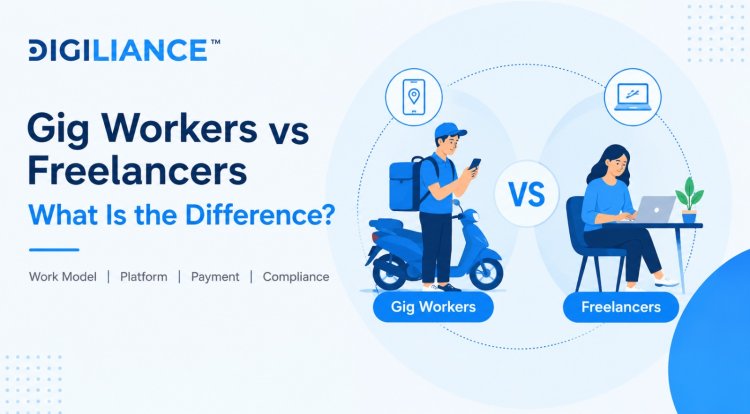
The terms gig worker and freelancer are often used interchangeably, but they are not necessarily the same from a legal or contractual perspective. This distinction is important when determining applicable compliance and social-security requirements.
|
Aspect |
Gig Worker |
Freelancer |
|---|---|---|
|
Nature of work |
Usually task-based or short-term |
Usually project or service-based |
|
Platform involvement |
May work through a digital platform |
Often works directly with clients |
|
Legal recognition |
Specifically recognized under the Code on Social Security, 2020 |
Not automatically a separate statutory category under the Code |
|
Client relationship |
May work with one or multiple platforms |
Generally works with multiple clients |
|
Payment |
Often based on tasks, trips, orders or assignments |
Usually based on project, deliverable or agreed fee |
|
Compliance focus |
Classification, registration and applicable social-security framework |
Contractual terms, taxation, documentation and correct classification |
A freelancer may fall within the statutory definition of a gig worker depending on the nature of the work arrangement, but freelancers should not automatically be classified as gig workers.
How Labour Codes Address Gig Workers in India
The Code on Social Security, 2020 contains specific provisions relating to unorganised workers, gig workers and platform workers.
Registration of Gig and Platform Workers
Section 113 provides for registration of eligible unorganised workers, gig workers and platform workers for the purposes of the social-security framework. The provision also allows for self-registration in the prescribed manner.
Registration is important because registered workers can become eligible for benefits under applicable social-security schemes. Businesses should therefore understand how worker registration interacts with the applicable schemes and the nature of their workforce arrangements.
Social Security Schemes
Section 114 allows the Central Government to frame and notify social-security schemes for gig and platform workers. These schemes may cover areas such as:
-
Life and disability cover
-
Accident insurance
-
Health and maternity benefits
-
Old-age protection
-
Crèche benefits
-
Other notified benefits
The Code also provides for different funding mechanisms involving the government, beneficiaries and aggregators, depending on the scheme.
Social Security Fund
The Code provides for a Social Security Fund framework to support social-security and welfare measures for eligible categories of workers.
This represents an important shift because gig and platform workers are now specifically addressed within the statutory social-security framework rather than being treated only as an informal workforce category.
For more information on the Code, organisations can refer to FAQs on the Code on Social Security, 2020
Aggregator Contribution: What Businesses Need to Know
One of the most discussed provisions is the contribution applicable to specified aggregators.
Under Section 114(4) of the Code on Social Security, 2020, the contribution is to be at a rate:
-
Not less than 1%
-
Not more than 2% of annual turnover, as notified by the Central Government
However, the contribution is subject to an additional ceiling: it cannot exceed 5% of the amount paid or payable by the aggregator to gig workers and platform workers. Certain taxes, levies and cess payable to the Central Government are excluded from the annual turnover calculation.
Important: The 1–2% Is a Statutory Range
Businesses should not state that every aggregator is currently required to pay a fixed 1% or 2%. The applicable contribution should therefore be determined by referring to the relevant provisions, rules and notifications rather than applying the 1%–2% range as a universal fixed rate.
The Code provides the 1%–2% statutory range, while the applicable rate is to be notified by the Central Government. Section 114(5) also states that the commencement date for the aggregator contribution will be notified separately.
This distinction is important when preparing compliance content or advising businesses.
Social Security (Central) Rules, 2026
The Social Security (Central) Rules, 2026 were notified on 8 May 2026.
The Rules provide procedural mechanisms for implementing the social-security framework, including provisions concerning aggregators and contribution-related compliance.
For aggregators, the prescribed framework includes assessment and reporting requirements. Where the contribution becomes payable under the notified framework, the Rules provide timelines including:
-
30 June – provisional assessment/contribution process
-
31 October – final return after the relevant audited information becomes available
-
1% interest per month or part of a month on delayed contribution, where contribution is payable and remains unpaid
These timelines should not be interpreted as meaning that every aggregator automatically had a contribution payment liability from 30 June 2026. The applicable contribution rate and commencement remain subject to the notification framework under Section 114.
e-Shram and Gig Workers
The e-Shram system forms part of India’s broader effort to create a database of unorganised workers, including gig and platform workers.
Eligible workers can use the e-Shram platform for registration and access to information about applicable social-security schemes.
For businesses engaging gig workers, understanding the relationship between worker registration, applicable schemes and contractual arrangements will become increasingly important as the regulatory framework develops.
Key Compliance Considerations for Businesses
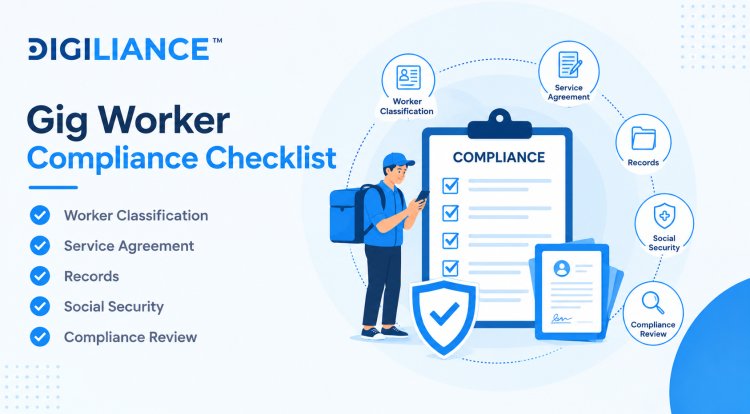
Businesses should review their gig and freelance arrangements from multiple compliance perspectives.
1. Correct Worker Classification
Determine whether the individual is an employee, consultant, freelancer, contractor, gig worker or platform worker based on the actual nature of the engagement. Businesses should consider the contractual terms as well as the practical manner in which the work is performed.
The label used in a contract should not be the only factor considered.
Businesses can also review their contractor compliance requirements when managing external or flexible workforce arrangements.
2. Clear Service Agreements
Written agreements should clearly define:
-
Scope of work
-
Deliverables
-
Payment terms
-
Duration of engagement
-
Confidentiality obligations
-
Intellectual property rights
-
Termination provisions
- Data protection responsibilities
A clearly drafted agreement helps establish the commercial terms of the engagement and reduces ambiguity regarding responsibilities, payments and ownership of work. Agreements should also be reviewed when the scope or structure of the engagement changes.
3. Maintain Proper Records
Businesses should maintain relevant contracts, invoices, payment records, worker details and other supporting documentation.
Proper records make compliance reviews easier and help demonstrate the actual nature of the relationship. They can also help businesses respond to internal reviews, audits or regulatory queries. Records should be maintained consistently throughout the engagement rather than created only when a compliance issue arises.
4. Monitor Labour Law Updates
The Labour Codes and related rules create a developing compliance framework. Businesses should regularly review government notifications, rules and applicable schemes rather than relying on outdated assumptions. This is particularly relevant for organisations operating across multiple locations or engaging large numbers of flexible workers.
5. Conduct Periodic Compliance Reviews
Organizations with a large flexible workforce should periodically review worker classification, contracts, payments and statutory obligations to identify potential gaps. Reviews can help identify inconsistent documentation, incorrect classification or changes in the working arrangement that may require further assessment.
Periodic labour compliance audits can help organisations identify documentation and statutory compliance gaps.
Best Practices for Managing Gig Workers and Freelancers
A practical compliance approach should include several connected controls rather than relying on contracts alone.
-
Classify workers correctly
-
Use clear written agreements
-
Maintain complete engagement and payment records
-
Review applicable social-security requirements
-
Monitor Labour Code notifications and rules
-
Conduct periodic compliance audits
-
Protect confidential and business data
-
Document changes in the workforce arrangement
These practices can help organisations maintain consistent documentation and identify potential compliance gaps as workforce arrangements change.
Conclusion
The growth of gig workers and freelancers is changing how businesses build and manage their workforce. Flexible engagements can provide access to specialised skills and greater operational flexibility, but they also require careful attention to classification, documentation, social security and compliance.
India’s Labour Codes, particularly the Code on Social Security, 2020, have brought gig and platform workers into the statutory social-security framework. With the Labour Codes effective from 21 November 2025 and the Social Security (Central) Rules, 2026 notified on 8 May 2026, businesses should keep their workforce practices aligned with the applicable legal framework.
Businesses looking to strengthen their compliance framework can explore Digiliance’s labour law compliance solutions
Frequently Asked Questions
1. Who is considered a gig worker in India?
Under the Code on Social Security, 2020, gig workers are recognised as a category of workers who perform work outside the traditional employer-employee relationship. The exact classification depends on the nature of the engagement.
2. Are freelancers automatically considered gig workers?
No. A freelancer is not automatically a gig worker. The classification depends on the actual nature and structure of the work arrangement.
3. When did the four Labour Codes become effective?
The four Labour Codes were made effective across India from 21 November 2025.
4. What does the Code on Social Security provide for gig workers?
The Code provides a framework for registration and social-security schemes for gig and platform workers, including potential benefits relating to accident insurance, health, maternity, disability and old-age protection.
5. What is the aggregator contribution under Section 114?
For specified aggregators, the Code provides a contribution range of 1% to 2% of annual turnover, as notified by the Central Government, subject to a ceiling of 5% of the amount paid or payable to gig and platform workers.
6. Is the 1%–2% aggregator contribution already a fixed rate for all aggregators?
No. The Code provides the statutory range, but the applicable rate is to be notified by the Central Government. The commencement date for the contribution is also to be notified.
7. When were the Social Security (Central) Rules, 2026 notified?
The Social Security (Central) Rules, 2026 were notified on 8 May 2026.
8. What records should businesses maintain for freelancers and gig workers?
Businesses should maintain relevant agreements, invoices, payment records, worker information, confidentiality provisions and other documents supporting the nature and terms of the engagement.